SoftPro® Elite HE Water Softener for Well Water (Best Seller & Lifetime Warranty)

$2,231.67
$1,327
Save 41%
In stock. Shipped within 1-3 days.
  • check FACTORY-DIRECT SAVINGS
  • check BUILT IN USA
  • check EASY INSTALLATION
  • check FREE SHIPPING
  • check LIFETIME WARRANTY
  • check 60-DAY MONEY BACK GUARANTEE

Product Addons

Product title
$19.99
Product title
$19.99
Product title
$19.99
32000
32000
40000
48000
64000
Softener ONLY
Softener ONLY
Softener + KDF
Softener + Pro Iron Filter
6 to 7 GPM
6 to 7 GPM
8 to 10 GPM
11+ GPM

100% Secure Checkout

Guaranteed Secure

  • American Express
  • Apple Pay
  • Diners Club
  • Discover
  • Google Pay
  • Mastercard
  • PayPal
  • Shop Pay
  • Visa
06 Jul 2026
Order Received
08 Jul 2026
Order Shipped
10 Jul 2026
Estimated Delivery

Built to Tame the Toughest Well Water
A High-Efficiency Softener That Actually Understands Private Wells

Private well water plays by its own rules.
Unlike city water, which arrives pre-treated and held to federal standards, water from a private well reflects whatever mineral and chemical profile exists in the local aquifer. That profile can include extreme hardness that fluctuates with seasonal water table changes, dissolved iron that attacks your resin bed without warning, manganese that deposits black staining on every surface it touches, and hydrogen sulfide that makes every glass of water smell like a sulfur spring.
No municipal report will tell you what's in your water. No city water softener is designed to handle what yours might throw at it.

The SoftPro Elite Well Water Softener Was Built Different
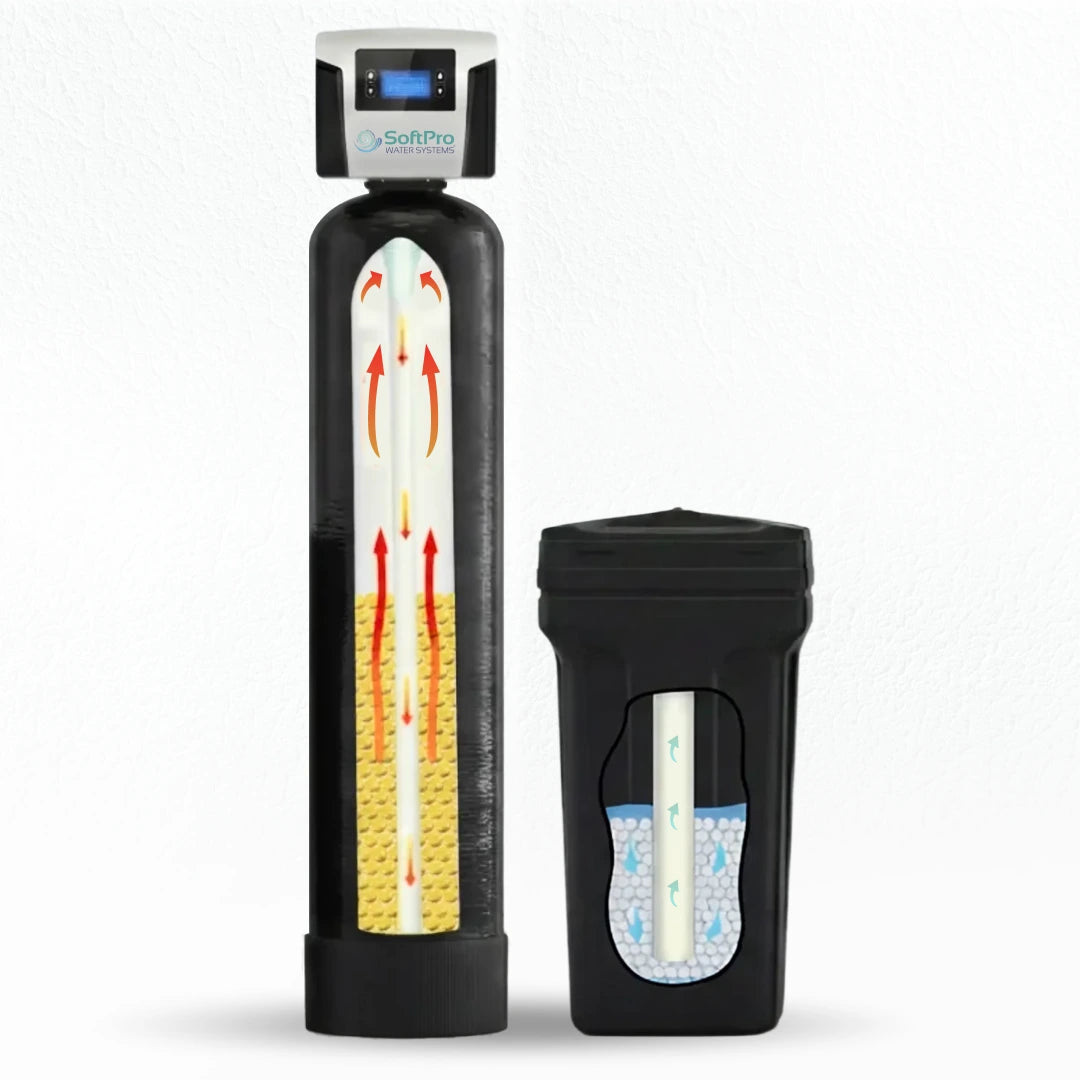
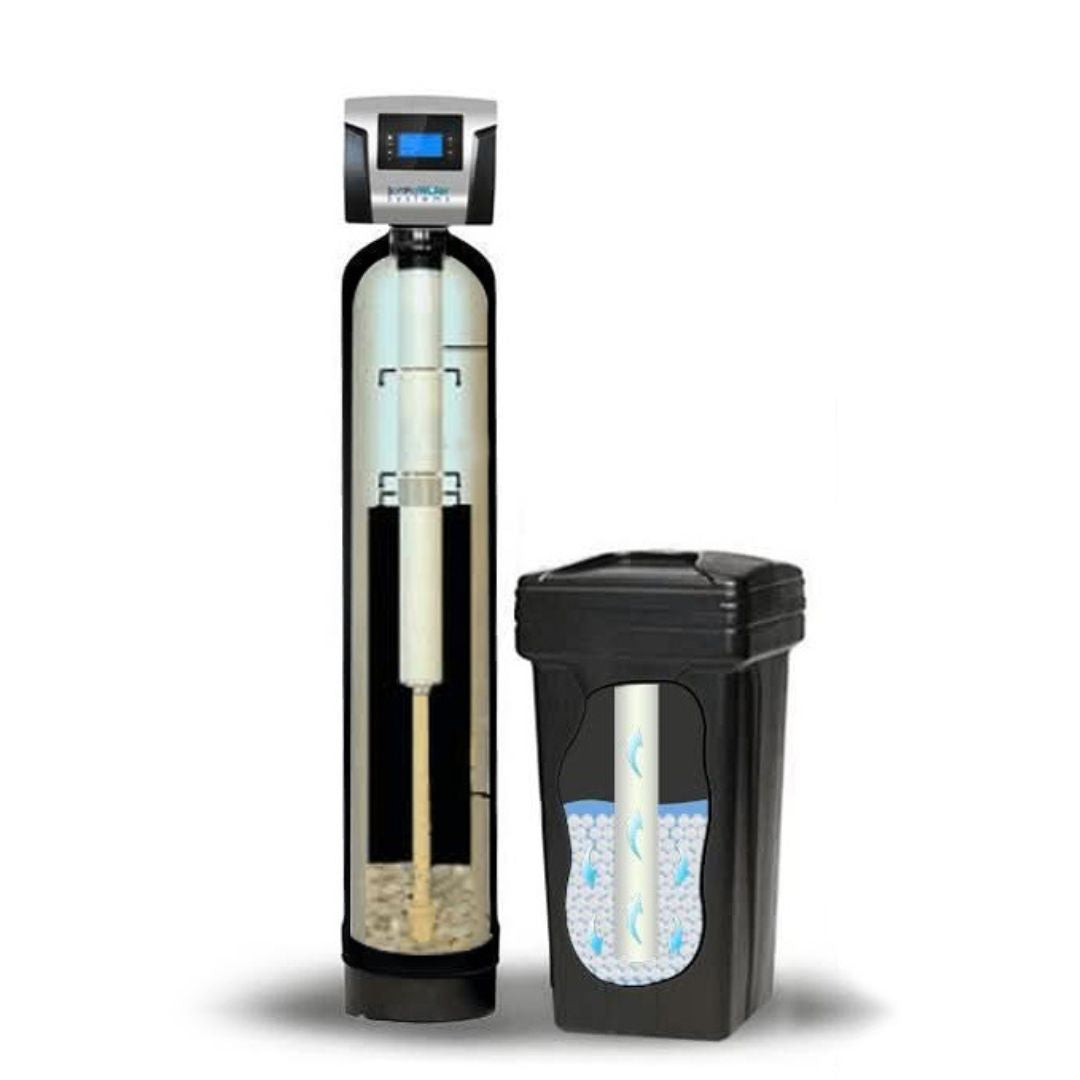
Built specifically around the demands of private well ownership. Its high-efficiency ion exchange design handles hardness — calcium, magnesium, and related dissolved minerals — with the same upflow regeneration precision and smart brine management that makes it one of the most salt-efficient softeners available.
But its well water engineering goes FURTHER. The system is calibrated for the higher regeneration frequency that well water iron levels demand. Its 10% crosslink resin withstands the oxidative stress and iron fouling that shorter-lived 8% resin can't. And it's designed from the ground up to integrate with dedicated iron and sulfur filtration upstream — so as your well water conditions evolve, your treatment system can grow with them.
This is NOT a city water softener adapted for well use with a different product label. It's an entirely separate system built around the reality that private well water is harder to treat, more variable, and more unforgiving of the wrong equipment than anything coming out of a municipal supply line.

Why the Filter Bundles Matter More for Well Water

Here's the brutal truth: A water softener cannot protect itself from iron.
When dissolved ferrous iron enters a softener's resin bed without pre-treatment, it binds to the exchange sites alongside calcium and magnesium — but it does NOT release cleanly during regeneration. Over time, iron loading degrades resin capacity, shortens media life, and turns a well-performing softener into a system that regenerates constantly and still delivers hard water.
Pre-treating iron before it reaches the resin isn't optional on well water with meaningful iron levels — it's the difference between a system that performs for a decade and one that needs resin replacement in three years.

Gold Package — Softener + KDF Iron Filter

The Gold bundle pairs the Elite softener with a whole-house KDF filtration system — the appropriate starting point for well water with dissolved iron in the low-to-moderate range, typically up to around 3 to 5 ppm.
KDF media uses a zinc-copper redox reaction to convert dissolved ferrous iron into insoluble particulate iron, which is then backwashed to drain. The result? Well water that reaches the softener's resin bed with its iron largely neutralized — protecting the media, extending the softener's service life, and eliminating the rust staining and metallic taste that dissolved iron produces in untreated systems.

Gold+ Package — Softener + Iron Master AIO Iron, Manganese & Sulfur Filter

For wells with higher iron concentrations, manganese, or hydrogen sulfide — the sulfur compound responsible for the rotten egg smell that makes some well water genuinely unpleasant — the Gold+ bundle replaces the KDF filter with the Iron Master AIO system.
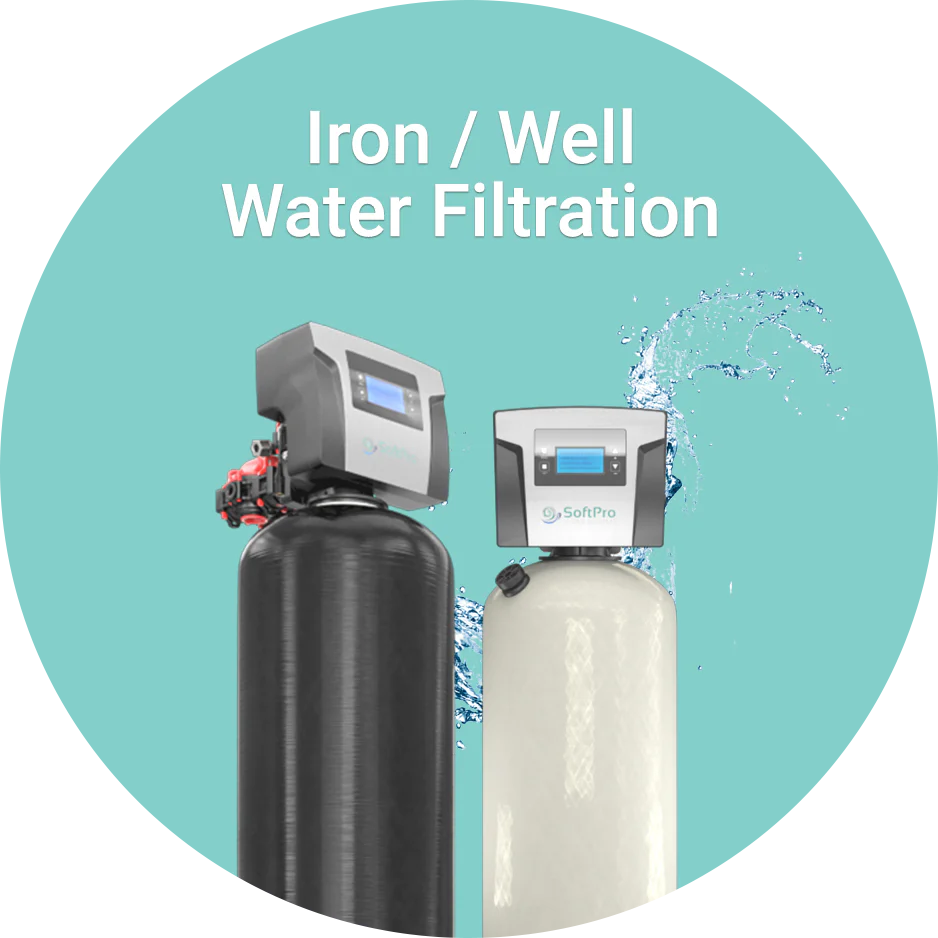
AIO stands for air injection oxidation, and it describes how this filter works: a controlled air pocket at the top of the media tank oxidizes dissolved iron, manganese, and hydrogen sulfide as water passes through, converting them into solid particles that are then captured by a bed of Katalox media and periodically backwashed to drain.
The Iron Master AIO handles iron concentrations FAR beyond what KDF can address, and its simultaneous treatment of manganese and hydrogen sulfide makes it the only filter capable of tackling the full spectrum of well water contaminants in a single unit.

What Each Package Actually Delivers

Softener Only — What It Delivers

• Complete hardness removal — calcium, magnesium, and all dissolved hardness minerals eliminated at the point of entry
• High-efficiency upflow regeneration using 25–30% less salt per cycle than conventional downflow softeners
• 10% crosslink resin for superior resistance to iron fouling and longer media life under well water conditions
• Smart metered control valve that tracks actual well water usage and regenerates based on real demand
• Suitable only where iron is below trace levels (under 0.3 ppm) — pair with a filter for any detectable iron

Gold — Softener + KDF Iron Filter

• Everything in the Softener Only package
• KDF redox filtration for dissolved ferrous iron removal up to approximately 3–5 ppm
• Resin protection — iron neutralized before it reaches the softener media bed
• Elimination of rust staining and metallic taste throughout the home
• Appropriate for wells with moderate iron and no significant sulfur presence

Gold+ — Softener + Iron Master AIO Iron, Manganese & Sulfur Filter

• Everything in the Softener Only package
• Air injection oxidation of dissolved iron, manganese, and hydrogen sulfide through Katalox media filtration
• Handles high iron concentrations, black manganese staining, and rotten egg sulfur odor simultaneously
• Most complete well water treatment available — addresses the full range of contaminants that damage plumbing, appliances, and resin
• Sized to your well pump's GPM — test before ordering

Everything Included in Your Order — No Hunting for Missing Parts

Softener Only Package

• SoftPro Elite HE whole-house well water softener in your chosen grain capacity (32K, 40K, 48K, or 64K)
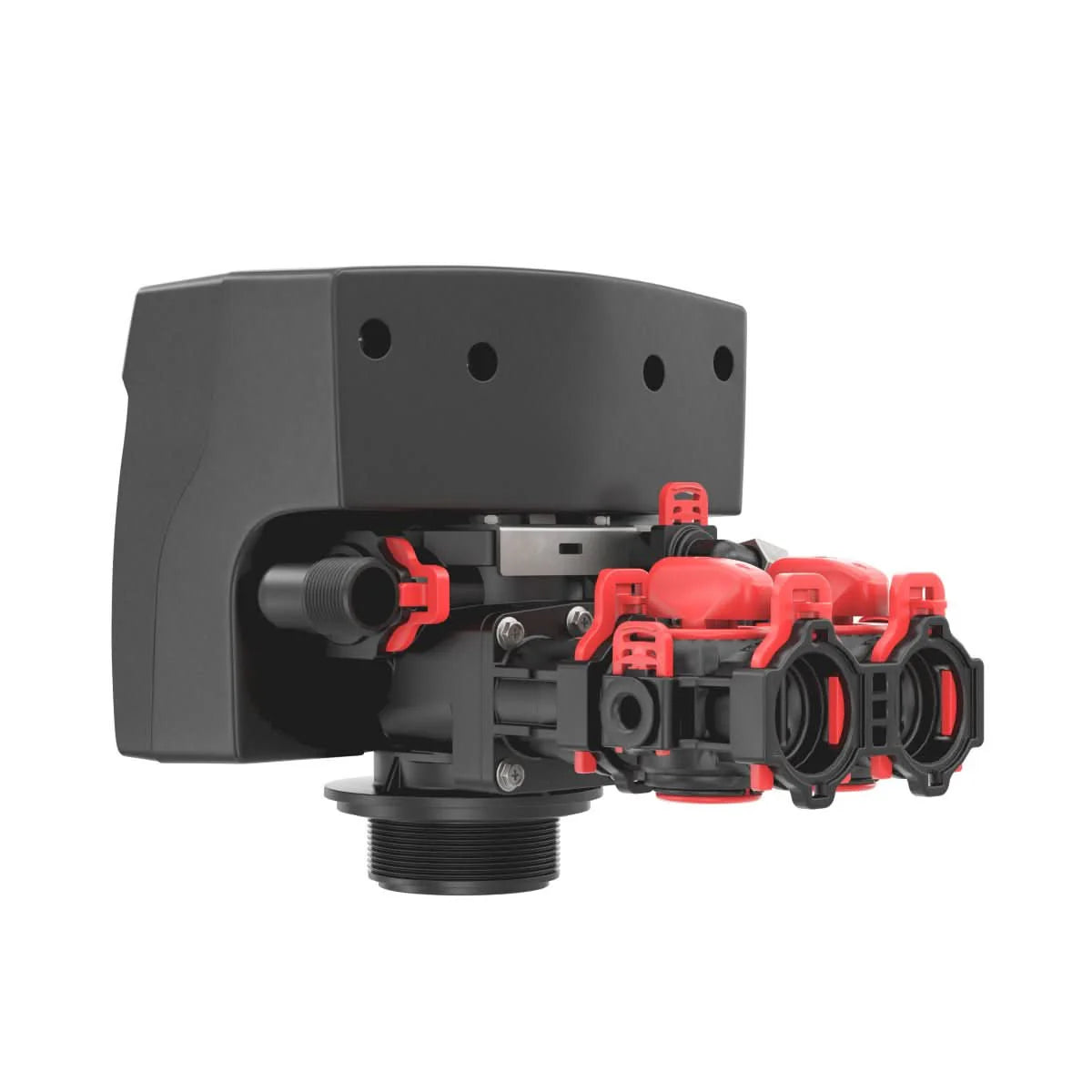
• Advanced upflow control valve with precision variable brining, metered demand regeneration, and 48-hour battery-free memory backup
• 10% crosslink resin tank — higher iron resistance and longer media life than standard 8% resin
• Heavy-duty brine tank with safety float valve for contained, reliable salt storage
• Bypass valve assembly — isolate the softener for maintenance without cutting off household water
• Full printed installation guide plus step-by-step video walkthrough access
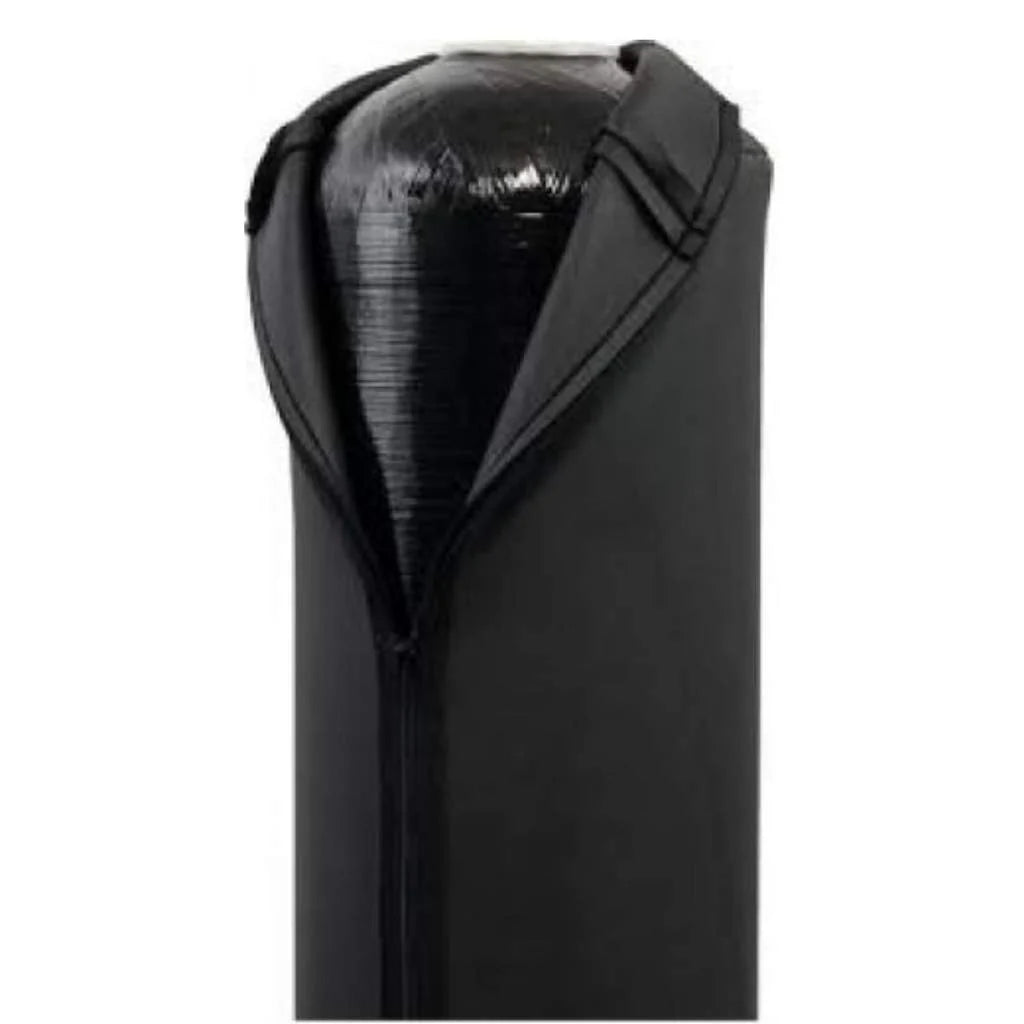
• Complimentary neoprene resin tank insulating jacket — while supplies last ($59 value)
• Live well water technical support before, during, and after installation at no charge

Gold Package — Adds KDF Whole-House Iron Filter

Everything in the Softener Only package, plus:
• Whole-house KDF iron filtration system sized to your well pump flow rate
• KDF redox media for dissolved ferrous iron and partial heavy metal reduction
• All interconnecting fittings and plumbing hardware for a clean dual-system installation
• Installation documentation specific to the softener-plus-iron-filter configuration
• Well water technical guidance for system programming and flow rate verification

Gold+ Package — Adds Iron Master AIO Iron, Manganese & Sulfur Filter

Everything in the Gold package, with the KDF filter replaced by the Iron Master AIO, plus:
• Iron Master AIO whole-house air injection oxidation system with Katalox media
• Integrated air injector and control head for automated backwash and air pocket maintenance
• Simultaneous treatment of dissolved iron, particulate iron, manganese, and hydrogen sulfide
• Sized to your well pump's GPM — flow rate confirmation required before system finalization
• Priority technical support for dual-system programming and well water optimization

Because Well Water Requires More Than a Basic Softener

And Most Softeners Deliver Exactly That

The private well softener market is full of city water systems wearing a different label. The underlying hardware — the control valve, the resin, the brine management — was designed for consistent, pre-treated municipal supply.
When that equipment encounters a well water profile with dissolved iron, fluctuating hardness, and pH variability, it STRUGGLES. The resin fouls. The valve clogs. Performance degrades quietly over months until you notice your water is hard again and your appliances are showing rust damage you thought you'd solved.

The SoftPro Elite Well Water Softener Is a Different Calculation
Its upflow regeneration design was chosen in part because upflow brining is more resistant to iron fouling within the resin bed during the regeneration process itself. Its 10% crosslink resin was specified because it withstands the oxidative stress and chemical variability of well water environments that cause standard resin to degrade prematurely.
Its higher regeneration frequency — calibrated for the iron loading typical of private wells — means the system flushes accumulated iron from the brine tank and lower resin zones more often, maintaining media integrity across years of operation.
Why the Gold and Gold+ Bundles Change the Equation
Iron staining, rotten egg odor, and black manganese deposits are NOT softener problems. They're pre-treatment problems that a softener alone will never solve — and that will actively DESTROY a softener's resin if left unaddressed.
The KDF filter in the Gold package handles the moderate iron scenario most common in shallow to mid-depth residential wells. The Iron Master AIO in the Gold+ package handles what the KDF can't — high iron, manganese, and sulfur, the combination found in deeper wells and wells drawing from iron-rich geological formations.

Section Image

Why a City Water Softener Will Fail on Your Private Well

And What to Use Instead
This is the question most softener manufacturers never answer directly.
City water softeners and well water softeners share the same basic ion exchange mechanism. What makes them different is everything else: the operational parameters, the resin specification, the regeneration frequency, the compatibility with upstream filtration, and the engineering tolerance for the variability that defines private well water.

City Water Is Consistent. Well Water Is Not.
A city water softener is programmed around known parameters. Municipal supply hardness is relatively stable, published in an annual report, and predictable enough that factory defaults on a control valve are usually close enough to work without fine-tuning. City water contains no iron, no manganese, no sulfur. The resin never encounters oxidative challenge beyond the chlorine residuals that come with municipal treatment.
Well water has NONE of those consistencies. Hardness in a private well can vary by 30 to 50% between dry season and wet season as the water table rises and falls and draws from different mineral strata. Iron levels that tested at 1 ppm in spring may reach 5 ppm in summer when groundwater concentrates. A well that showed no sulfur for five years can develop hydrogen sulfide as bacterial populations in the casing change.
A softener that was correctly sized and programmed at installation may be significantly undersized or over-cycling twelve months later simply because the water changed.

Resin Fouling — The Silent Killer of Well Water Softeners
Standard water softener resin is designed to exchange calcium and magnesium for sodium. It handles these minerals cleanly and releases them during regeneration. Iron does NOT follow those rules.
Dissolved ferrous iron enters the resin bed alongside hardness minerals, binds to the same exchange sites, and then oxidizes inside the bead during aeration at the surface of the brine solution. That oxidized iron does not flush out during a standard regeneration cycle. It accumulates on and inside the resin beads, blocking exchange sites and progressively reducing the resin's softening capacity.
Left untreated, iron fouling turns a fully functional softener into an expensive piece of plumbing that produces mildly hard water and regenerates twice as often as it should.
This is why pre-treatment with a dedicated iron filter is NOT an add-on for well water — it's the foundation of a system that will perform correctly over time. And it's why the SoftPro Elite's 10% crosslink resin matters: the denser polymer matrix is physically more resistant to the oxidative and mechanical stress of iron exposure within the bead structure, extending the time before fouling affects performance.

pH: The Factor Nobody Talks About
Well water pH is frequently outside the neutral 7.0 range that city water treatment maintains. Acidic well water — pH below 7 — is actively corrosive. It dissolves copper pipe, attacks brass fittings, etches the protective coating inside water heater tanks, and leaches lead from solder joints. It also accelerates resin degradation in a softener.
Alkaline well water — pH above 8 — encourages mineral precipitation, scale formation that can exceed what a well-performing softener can prevent, and conditions that promote manganese deposition even when manganese levels in the raw water appear low.
Before sizing and configuring a well water softener system, testing pH is NOT optional.

Iron, Manganese, and Hydrogen Sulfide

The Well Water Contaminants That Destroy Softeners and Ruin Water Quality
Most homeowners who discover their well has an iron problem only learn about it from the symptoms. By the time the rust stains appear on the toilet bowl and the kitchen sink, dissolved iron has already been cycling through the softener for months.
Understanding what each contaminant is, how it behaves, and which treatment addresses it is the only way to build a well water treatment system that solves the problem rather than masking it.

Particulate Iron (Ferric)
Already oxidized before entering your pipes. Shows as visible rust particles or orange sediment in the water. Visible reddish-brown sediment, orange staining immediately on contact, clogged aerators. Sediment pre-filtration, then Iron Master AIO for complete removal.

Manganese
Forms black or dark brown deposits on plumbing surfaces. Fouls softener resin and shortens media life without pre-treatment. Black staining around faucets and drain areas, dark particles in water, bitter metallic taste distinct from iron. Iron Master AIO addresses manganese alongside iron in most well water conditions.

Hydrogen Sulfide
Dissolved gas that produces a characteristic rotten egg smell. Doesn't always accompany iron — can occur independently based on aquifer geology and bacterial activity. Unmistakable sulfur odor strongest when hot water is running. Iron Master AIO with air injection oxidizes and removes hydrogen sulfide effectively.

Iron Bacteria
Naturally occurring bacteria that feed on dissolved iron. Produce a reddish-brown slime that accumulates in tanks, pipes, and the softener brine tank. Slimy orange or reddish growth inside the toilet tank, musty or oily odor. Requires shock chlorination of the well before treatment system installation. Periodic resin sanitization thereafter.

Critical: Iron concentration in a private well is NOT static. Seasonal variation, rainfall events, changes in well pump depth, and aging well casings can all cause iron levels to shift significantly over time. A water test that showed 1 ppm iron two years ago does not guarantee 1 ppm today. Annual testing of iron, manganese, pH, and total hardness is the minimum recommended monitoring schedule for any private well used as a primary household water supply.

Test Before You Buy

Why a Well Water Test Is the Starting Point for Every Treatment Decision

Every well is different. The appropriate treatment system for a household in rural Texas drawing from a limestone aquifer is NOT the right system for a property in upstate New York pulling from a glacial till formation.
Buying a water softener or an iron filter without testing your water first is guesswork and guesswork with well water produces systems that are either inadequate for your actual conditions or over-specified at unnecessary cost.
A complete well water test should cover at minimum: total hardness, iron (total and dissolved), manganese, pH, total dissolved solids, and hydrogen sulfide. For wells near agricultural areas, nitrates and coliform bacteria should be added to the panel. For older properties with galvanized or copper supply lines, lead and copper testing is worth including.

State-Certified Laboratory
The most accurate and comprehensive option. Many state departments of health maintain lists of certified testing laboratories. Collect samples using the lab's sterile kit and follow their collection protocol carefully — contaminated samples produce unreliable results. Full panel testing typically costs $100 to $300 depending on the parameters included.
Mail-In Test Kits
Several reputable water testing companies offer mail-in kits covering the parameters relevant to well water treatment. Look for kits that test specifically for iron, manganese, pH, and hardness as individual parameters — not just a general TDS reading, which is insufficient for treatment planning.
In-Home Test Strips
Useful for a quick field check of pH, hardness, and approximate iron levels. Not accurate enough for treatment system sizing decisions. Use strips for a rough orientation before ordering a proper test, not as the basis for your system configuration.
Free Test From Our Team
Contact us before purchasing and we can arrange a complimentary water test kit or review your existing test results and recommend the appropriate system configuration for your specific well water profile. Bring the numbers to our technical team before finalizing your order — specifically: total iron in ppm, manganese in ppm, hydrogen sulfide presence, pH, and total hardness in GPG.

Installation Overview — Designed for Homeowners, Handymen, and Plumbers

The SoftPro Elite Well Water Softener installs at the point of entry — typically where your well pressure tank feeds the main household supply line. This location ensures that every tap, shower, and appliance in the home receives treated water before it reaches any outlet.
Depending on the package selected, the iron filter installs upstream of the softener so that iron-loaded water is treated before it can contact the resin bed.

The SoftPro Elite Well Water Softener installs at the point of entry — typically where your well pressure tank feeds the main household supply line. This location ensures that every tap, shower, and appliance in the home receives treated water before it reaches any outlet.
Depending on the package selected, the iron filter installs upstream of the softener so that iron-loaded water is treated before it can contact the resin bed.

Standard Installation Sequence for a Softener-Plus-Filter Bundle
Well pump → pressure tank → iron filter (Gold or Gold+) → water softener → household supply
This upstream-to-downstream order is ESSENTIAL — the filter must come before the softener, not after.

What a Typical Installation Involves
• Identifying the installation location — before the pressure tank if possible, or immediately after it on the supply line feeding the home
• Shutting off the well pump at the breaker and releasing pressure from the system before cutting into supply lines
• Connecting the filter and softener in the correct upstream sequence with bypass valves on each unit for independent maintenance access
• Routing a drain line from both the softener control valve and the iron filter backwash to an appropriate discharge point
• Connecting power to both control valves — standard 110V outlets required for each unit
• Programming both systems with your hardness level, iron concentration, and household water usage data
• Running a manual backwash on the iron filter and a manual regeneration on the softener before placing the system in regular service

Important for Well Water Installations
Bypass outside spigots and irrigation lines so that untreated well water supplies these outlets — softened water on irrigation is not recommended, and it wastes salt treating water that serves no household purpose.
If your well has not been shock-chlorinated recently and iron bacteria are suspected, perform a well shock treatment before commissioning the new equipment. Iron bacteria in the well casing will re-contaminate a new system within weeks if the source is not addressed.

Live Support During Installation
Our technical team includes specialists with direct experience in well water system configurations. Whether you're a first-time installer or a plumber working with a new well water layout, we're available by phone and video during business hours to work through any step of the process in real time.

Section Image

What Warranty Support Looks Like in Practice

• Direct contact with the same team who guided your purchase — not a third-party warranty processor
• Remote diagnosis first — the majority of well water system issues are resolved by phone or video with no parts shipment required
• Replacement components dispatched immediately when a diagnosis confirms a warranty claim

Warranty details

Four Engineering Features That Distinguish This System for Well Water

Icon

Precision Variable Brining

Before each regeneration cycle, the control valve pre-calculates 70% of the estimated brine volume needed. Immediately before the cycle begins, it calculates the precise additional brine required to regenerate only the portion of the resin bed that's been depleted since the last cycle. The result? A system that never wastes salt regenerating resin that still has functional capacity — saving up to 30% more salt than fixed-brine designs. For a well water system regenerating four to seven times per month rather than twice monthly, this efficiency advantage compounds significantly over a year of operation.

Icon

Soft Water Quick-Recharge

When the control valve's real-time capacity monitoring detects that remaining softening capacity has dropped below 3%, a focused 15-minute mini-regeneration automatically restores sufficient capacity to maintain soft water delivery through the rest of the day. The full scheduled overnight regeneration still runs at 2:00 AM. This safety mechanism ensures that even on high-demand days, soft water reaches every tap without interruption.

Icon

Smart Clean Auto-Sanitize

If no water flow is detected for seven consecutive days, the control valve automatically initiates a brief sanitizing cycle. For a well water system, this feature carries particular importance: well water resin beds are more susceptible to iron bacteria colonization than city water systems during periods of stagnation. The seven-day auto-sanitize cycle disrupts potential microbial growth in the resin and brine tank before it can establish — protecting both the media quality and your household's water safety during extended absences or seasonal property closures.

Icon

Soft Water Brine Tank Refill

After each regeneration, the system refills the brine tank using water that's already been softened by the resin rather than raw incoming well water. On a private well where incoming water may carry trace dissolved iron even after upstream filtration, this detail prevents that iron from accumulating in the brine solution over successive regeneration cycles. A cleaner brine solution produces more consistent regeneration chemistry and extends the interval between required brine tank cleanings.

Sizing a Well Water Softener

Why the Standard Formula Needs a Well Water Adjustment
The standard softener sizing formula — people times 75 gallons per person per day times hardness in GPG — gives you a starting point for any softener. For well water, that starting point needs adjustment for two factors that city water buyers never encounter: iron loading on the resin, and higher regeneration frequency.

The Iron Adjustment
Dissolved iron in well water occupies resin exchange sites just as calcium and magnesium do. As a rough rule of thumb used in the water treatment industry, every 1 ppm of iron in your well water should be treated as equivalent to 4 GPG of additional hardness for the purpose of resin capacity calculation.
If your water tests at 15 GPG hardness and 2 ppm iron, size the system as if the hardness were 15 + (2 × 4) = 23 GPG.

The Regeneration Frequency Consideration
A well water softener typically regenerates four to seven times per month, compared to two to four times for a city water system of equivalent capacity. More frequent regeneration means more salt consumption per week, even with the efficiency advantages of upflow design and precision brining.
Sizing up by one capacity tier from the strict formula result provides a larger buffer between regeneration cycles — reducing the frequency further and lowering weekly salt consumption.

Quick Sizing Guide
1 to 2 people, under 15 GPG hardness, under 1 ppm iron — 32,000 grains: Adequate for small households with low well water mineral challenge.
2 to 4 people, 10 to 20 GPG hardness, 1 to 3 ppm iron — 40,000 to 48,000 grains: Covers the most common residential well water scenario with comfortable regeneration intervals.
4 to 6 people, 15 to 25 GPG hardness, or 3+ ppm iron — 48,000 to 64,000 grains: Larger capacity buffer accommodates the combined demand of household size and elevated iron-adjusted hardness.
Very hard water above 25 GPG or iron above 5 ppm with any household size — 64,000 grains: Maximum capacity for demanding well water conditions. Pair with Iron Master AIO pre-filtration.
If your iron levels are above 3 to 5 ppm, the KDF filter in the Gold package may not fully protect the resin at those concentrations under sustained use. The Iron Master AIO in the Gold+ package is the appropriate pre-treatment at higher iron levels.

KDF vs Iron Master AIO — The Honest Guide
This is the decision that most well water softener buyers get wrong — not because they're careless, but because the product page rarely gives them the information they need to make it.
Here it is in plain terms.

Softener Only
Not suitable if iron is present above trace amounts. Best suited for wells with very low iron under 0.3 ppm and hardness only.

Gold — KDF Filter
Handles up to approximately 3 to 5 ppm dissolved iron. Limited manganese reduction. Does not address hydrogen sulfide or significant sulfur odor. Requires 6 to 10 GPM pump flow rate. Good value for moderate iron conditions. Best suited for wells with moderate iron and no sulfur presence.

Gold+ — Iron Master AIO
Handles up to 30+ ppm dissolved and particulate iron. Effective manganese removal alongside iron. Air injection oxidizes and removes hydrogen sulfide. Must be matched to your pump flow rate. Highest investment — justified by comprehensive treatment. Fully protects softener resin from fouling. Best suited for high iron, manganese, sulfur, or any combination of well water contaminants.

The safest approach: get a full water test first, share the results with our team, and let us confirm the right package for your specific conditions. The KDF and Iron Master AIO address genuinely different problems at different scales — buying the wrong one for your well means living with either under-treatment or unnecessary cost.

Installation Made Easy
For Well Water Homeowners, Handymen, and Plumbers
A clear installation sequence, detailed video guidance, and live well water specialists available by phone means you're never working through a well water installation alone.
• Step-by-step installation video guides covering both single-unit and dual-system (filter plus softener) well water configurations
• Clear documentation of the correct installation sequence — iron filter upstream before the softener, with bypass valves on each unit for independent maintenance
• Live technical support from well water specialists available during business hours to guide any step of the installation process by phone or video call

Install Guides
Section Image

The Financial Case for Treating Your Well Water Properly

Costs That Disappear When the Water Is Right

The financial argument for a quality well water treatment system is different from the city water calculation. City water homeowners save on soap, detergent, and water heating efficiency. Well water homeowners save on all of those things — and also on the repair and replacement costs that iron, manganese, and untreated hardness impose on a home's plumbing infrastructure over time.

Plumbing and Fixture Replacement
Iron staining doesn't wash off with household cleaners once it's had weeks to set into porcelain and stainless steel. Fixtures stained beyond cleaning require replacement. Pipes carrying iron-laden water develop rust scale that restricts flow progressively over years and eventually requires replacement. A treatment system that stops iron at the entry point eliminates these costs before they begin.

Water Heater and Appliance Life
A water heater operating on hard, iron-containing well water accumulates scale and iron deposits on its heating element at a rate that dramatically exceeds what city water conditions produce. The combination of hardness scale for thermal insulation and iron deposits for corrosive degradation shortens water heater life from 12 to 15 years to as few as 5 to 8 years in severe cases. Soft, iron-free water eliminates both damage mechanisms.

Detergent and Cleaning Product Waste
Hard well water suppresses soap lathering and leaves mineral residue on every surface it contacts. Households on untreated well water consistently use more cleaning product to achieve the same result as a soft water household. The annual saving is modest per product but meaningful in aggregate.

Bottled Water and Filter Replacements Households with metallic-tasting, sulfur-smelling well water often supplement with bottled water or point-of-use filters for drinking. A Gold+ bundle that removes iron, manganese, and sulfur throughout the entire home eliminates both expenses — no more bottled water deliveries, no more under-sink filter cartridge changes.

Reduced Cleaning Labor Rust
staining in bathrooms, orange deposits in toilet bowls, and mineral scale on shower surfaces all require regular physical effort to manage. Iron-free, soft water homes don't produce these deposits. Weekly cleaning becomes materially faster and less physically demanding than in homes where iron and hardness are untreated.

Total System Payback
The combination of avoided plumbing repairs, extended appliance life, reduced cleaning product consumption, and elimination of bottled water expense consistently delivers annual savings that place the system payback well within the warranty period for most rural well water households.

The Intelligence Behind the System

Control Valve Features That Well Water Specifically Benefits From

Vacation Mode
Activating Vacation Mode suspends regeneration cycles while the household is unoccupied. If no water flow is detected for seven consecutive days, the system overrides the vacation suspension and performs a brief sanitizing refresh — a well water-specific concern because stagnant water in the resin bed creates conditions that can encourage iron bacteria growth. The system protects itself even when you've forgotten to.
Auto System Refresh
When remaining resin capacity drops below 3% of total rated grain capacity, the control valve triggers a targeted 15-minute mini-regeneration to restore soft water delivery. This is followed by a full regeneration at the scheduled 2:00 AM time. For a well water system where iron-adjusted hardness may deplete the resin faster than a city water system of equivalent size would, this safety net ensures soft water reaches every tap even on days of unexpected peak demand.
Auto Reserve
The control valve maintains a calculated soft water reserve equal to approximately 15% of total capacity — calibrated based on your household's observed daily consumption. Less efficient systems require reserves of 25 to 30% because their regeneration cycles are less targeted. The Elite's precision allows a smaller reserve without risk of hard water breakthrough, which means more of the resin's capacity is working for you at all times.
48-Hour Battery-Free Memory
The self-charging internal capacitor retains all programmed settings — time, date, hardness level, iron-adjusted parameters, and regeneration schedule — for a minimum of 48 hours without mains power. For rural well water properties where power outages during storms are more common than in urban areas, this uninterrupted memory continuity means the system resumes its programmed schedule the moment power returns without any intervention required.
Section Image

Bundle and Solve the Whole Problem

Because Well Water Problems Rarely Come Alone

Hardness is rarely the only issue in private well water. For many homeowners, it's not even the most visible one. Iron staining on the toilet bowl, a sulfur smell in the morning shower, orange deposits around the dishwasher drain, black rings around the bathroom tap — these are the symptoms that drive well water homeowners to search for a solution in the first place.
A softener alone addresses NONE of them.
The Gold and Gold+ bundles pair the Elite's high-efficiency softening with targeted upstream filtration designed specifically for well water conditions. This isn't about upselling. It's about the fact that a softener operating behind an iron filter performs correctly for a decade, while a softener operating without one may show signs of iron fouling within a few years.
Buying the right system configuration from the start is a better investment than buying a softener now and an iron filter later as a remedial measure after resin damage has already occurred.

  • The Gold package pairs the Elite with a KDF iron filter — the right solution for wells with dissolved iron in the low to moderate range, where sulfur is not a factor and pump flow supports KDF operation
  • The Gold+ package pairs the Elite with the Iron Master AIO — air injection oxidation with Katalox media for high iron, manganese, and sulfur conditions that require a more powerful pre-treatment solution
  • Both bundles are configured at the point of sale around your specific well pump flow rate and water test results — not around a generic specification
Section Image

Well Water Specialists

Before You Buy, During Installation, and for the Life of Your System

Well water treatment is a genuinely specialized field. The variables that affect the right system configuration — iron species, pH, manganese, sulfur, pump flow rate, well depth, aquifer geology — require practical knowledge that a general water softener sales team simply doesn't have.
Our technical team has guided thousands of well water homeowners through exactly this decision process.
• Pre-purchase water test review — share your test results and we'll confirm the right system configuration, grain capacity, and filter package for your specific well water chemistry
• Flow rate guidance — we'll help you calculate or verify your well pump's GPM before you finalize an order involving the Iron Master AIO
• Live installation support for both single-unit and multi-system well water configurations — available by phone and video during business hours
• Long-term maintenance advice — from resin cleaner timing to iron filter media monitoring to annual well water retesting recommendations

Questions Well Water Homeowners Ask — Answered Honestly

Q: How much salt does the system use on well water?
More than it would on city water with equivalent hardness — because iron in well water requires more frequent regeneration than hardness alone. On average, a three to four person household with moderately hard well water and low-to-moderate iron levels uses one 40-pound bag of salt every six to ten weeks with the Elite's upflow precision brining. Higher iron levels or harder water will shorten this interval. The Elite uses significantly less salt per cycle than a conventional downflow softener at equivalent regeneration frequency — that efficiency advantage is more pronounced on well water because the higher regeneration frequency makes each cycle's salt efficiency count for more over the course of a year.
Q: Will this system reduce my water pressure?
Not meaningfully under normal conditions. The SoftPro Elite uses 1" internal plumbing throughout the control valve, sized for the high-flow demands of larger homes. For well water installations, the more relevant pressure consideration is the iron filter upstream — both the KDF and the Iron Master AIO introduce some resistance as water passes through the media bed. In practice, most homes experience no perceptible pressure change at individual fixtures. If pressure drop is a concern at your installation, contact us to discuss the specific filter sizing and your pump's pressure specifications.
Q: How often will the softener regenerate on well water?
More frequently than a city water softener of the same capacity — typically four to seven times per month rather than the two to four times common in city water applications. The higher frequency reflects the combined demand of hardness removal and the additional resin loading that dissolved iron creates even after upstream filtration. The Elite's precision brining and upflow design mean that each regeneration uses less salt than a conventional system would, so the total monthly salt consumption remains competitive even at higher regeneration frequency.
Q: Do I need to test my well water before ordering?
Yes, strongly recommended. Your well's iron level and your pump's flow rate are the two specifications that determine which package is appropriate for your installation. Without these numbers, there's a meaningful risk of ordering a filter package that's either insufficient for your iron concentration or incompatible with your pump's GPM. We can arrange a complimentary test kit or review existing test results before you finalize your order.
Q: What is the difference between the Gold (KDF) and Gold+ (Iron Master AIO) packages?
The KDF filter in the Gold package uses a zinc-copper redox reaction to convert dissolved ferrous iron into particulate form for removal. It's effective for iron concentrations up to approximately 3 to 5 ppm and doesn't address hydrogen sulfide or significant manganese. The Iron Master AIO in the Gold+ package uses air injection oxidation followed by Katalox media filtration to address high iron concentrations, manganese, and hydrogen sulfide simultaneously. The AIO is a more powerful and more comprehensive pre-treatment system, and it requires a minimum pump flow rate to backwash effectively. If your water has sulfur odor, noticeable manganese staining, or iron above 5 ppm, the Gold+ is the appropriate choice.
Q: Can I add an iron filter later if I start with just the softener?
Yes — both the KDF and the Iron Master AIO can be added to an existing softener installation as upstream pre-treatment. However, if your well water already has detectable iron at installation, we'd recommend pairing the softener with appropriate filtration from day one. Running the softener on iron-containing water for even a few months before adding the iron filter allows fouling to begin accumulating in the resin. Starting with a clean resin bed and maintaining it behind effective pre-treatment from the first regeneration cycle produces a system that performs correctly from the outset.
Q: What maintenance does a well water softener require beyond a city water system?
The standard salt level check and annual brine tank cleaning apply to both. Well water adds a few additional considerations: periodic resin cleaner treatment — typically once or twice a year — to manage iron accumulation in the resin bed even with upstream filtration. Annual well water retesting to confirm that iron, hardness, and pH haven't shifted significantly since the system was configured. For the Iron Master AIO, periodic inspection of the air injector and backwash frequency verification to confirm the system is cleaning effectively at your current pump flow rate.
Q: Does the Smart Clean feature address iron bacteria specifically?
It provides a degree of protection, but it's not a substitute for proper well sanitation. The seven-day auto-sanitize cycle that runs when no water use is detected disrupts potential microbial growth in the resin bed and brine tank during periods of stagnation. It won't eliminate an established iron bacteria colony in a well casing. If iron bacteria are present in your well, the correct approach is to shock-chlorinate the well before the new treatment system is commissioned, then maintain the auto-sanitize feature as ongoing passive protection.
Section Image

The Complete Guide to Choosing a Water Softener for Private Well Water

Choosing a water softener for a private well is a fundamentally different decision from choosing one for a city water supply. The product selection process, the sizing methodology, the bundle configuration, and the long-term maintenance commitments all differ in ways that are rarely explained on product pages — and that lead a significant number of well water homeowners to buy systems that are either inadequate for their conditions or poorly matched to their specific well water chemistry.

This guide covers the full decision process from first principles.

Know Your Well Pump Flow Rate

The One Specification That Determines Your Filter Size
Your well pump's flow rate in gallons per minute determines which size Iron Master AIO system your installation can support. An iron filter that requires 10 GPM to backwash correctly will NOT function properly on a pump that delivers 6 GPM — it will fail to clean the media bed effectively, and iron removal performance will degrade within weeks.

How to Measure Your Well Pump's Flow Rate
• Turn off all water in the home and locate a hose bib or outdoor tap close to the pressure tank
• Fully open the tap and let it run for 30 seconds to stabilize flow
• Place a 5-gallon bucket under the flow and time exactly how long it takes to fill completely
• Divide 5 gallons by the number of seconds it took to fill, then multiply by 60 — this gives you GPM
• Example: if the bucket filled in 45 seconds → 5 ÷ 45 × 60 = 6.7 GPM

Matching Your Flow Rate to the Right System
6 to 7 GPM: Suitable for the standard Iron Master AIO configuration. Covers most residential well installations with a typical submersible pump. Sufficient for the Gold KDF filter at all sizes.
8 to 10 GPM: Required for mid-size Iron Master AIO configurations. Common in homes with newer high-output submersible pumps or shallow well jet pumps. Provides better backwash velocity and media cleaning.
11+ GPM: High-flow installations — common in larger properties or commercial-adjacent residential wells. Requires the largest Iron Master AIO configuration for effective backwash.
If you're unsure of your pump's flow rate or if your pump is aging and may not sustain its rated output, contact us before ordering the Gold+ package. We'd rather take a phone call and help you get the right size than have you install a system that underperforms because the backwash velocity is insufficient for your pump.

Whole-House Performance Redesigned for Private Well Water

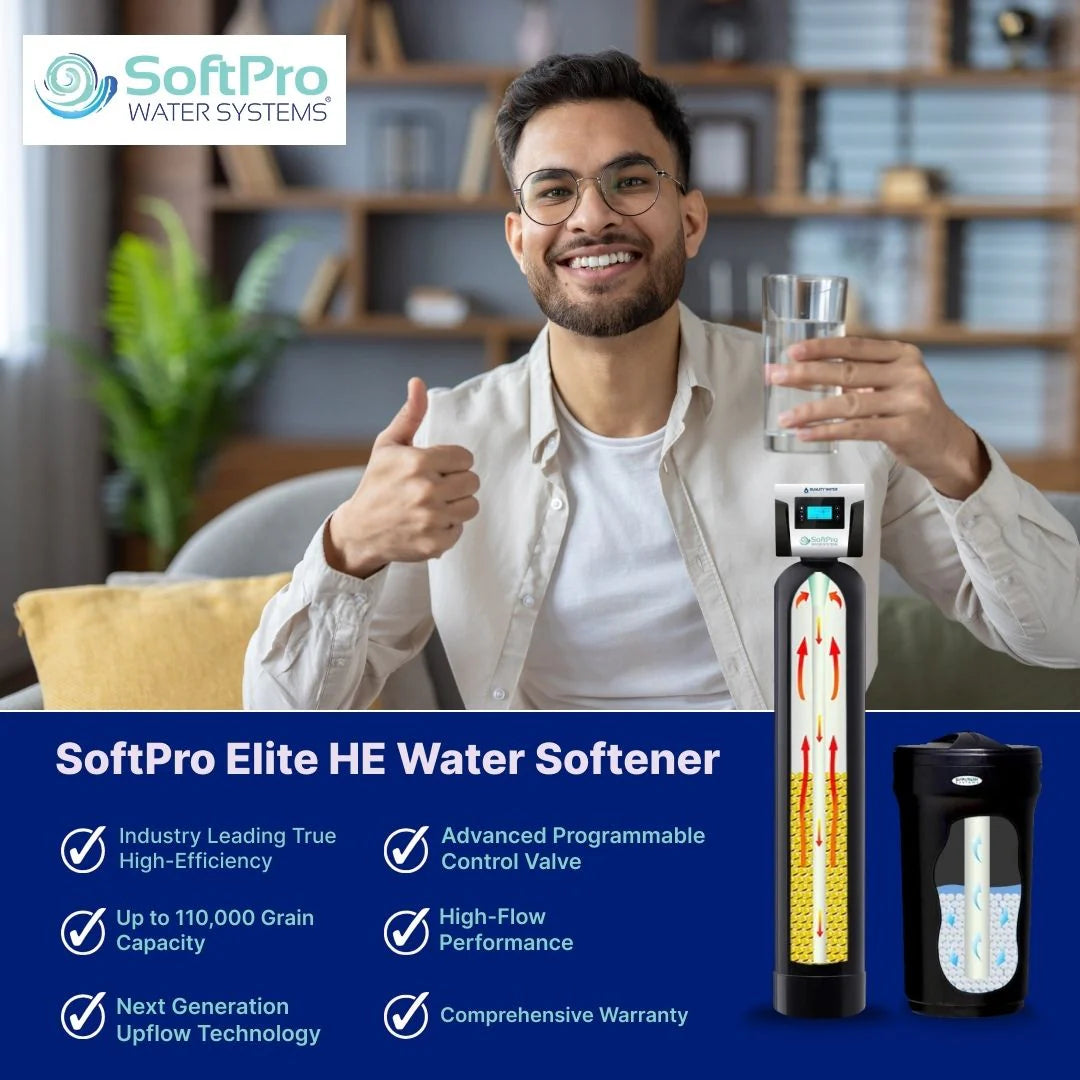
The SoftPro Elite Well Water Softener Delivers High-Efficiency Softening
In a configuration tuned for the iron exposure, hardness variability, and operational demands that private wells place on residential treatment equipment.
• High-efficiency upflow regeneration that uses 25–30% less salt per cycle than conventional downflow softeners — even at the higher regeneration frequency well water iron levels require
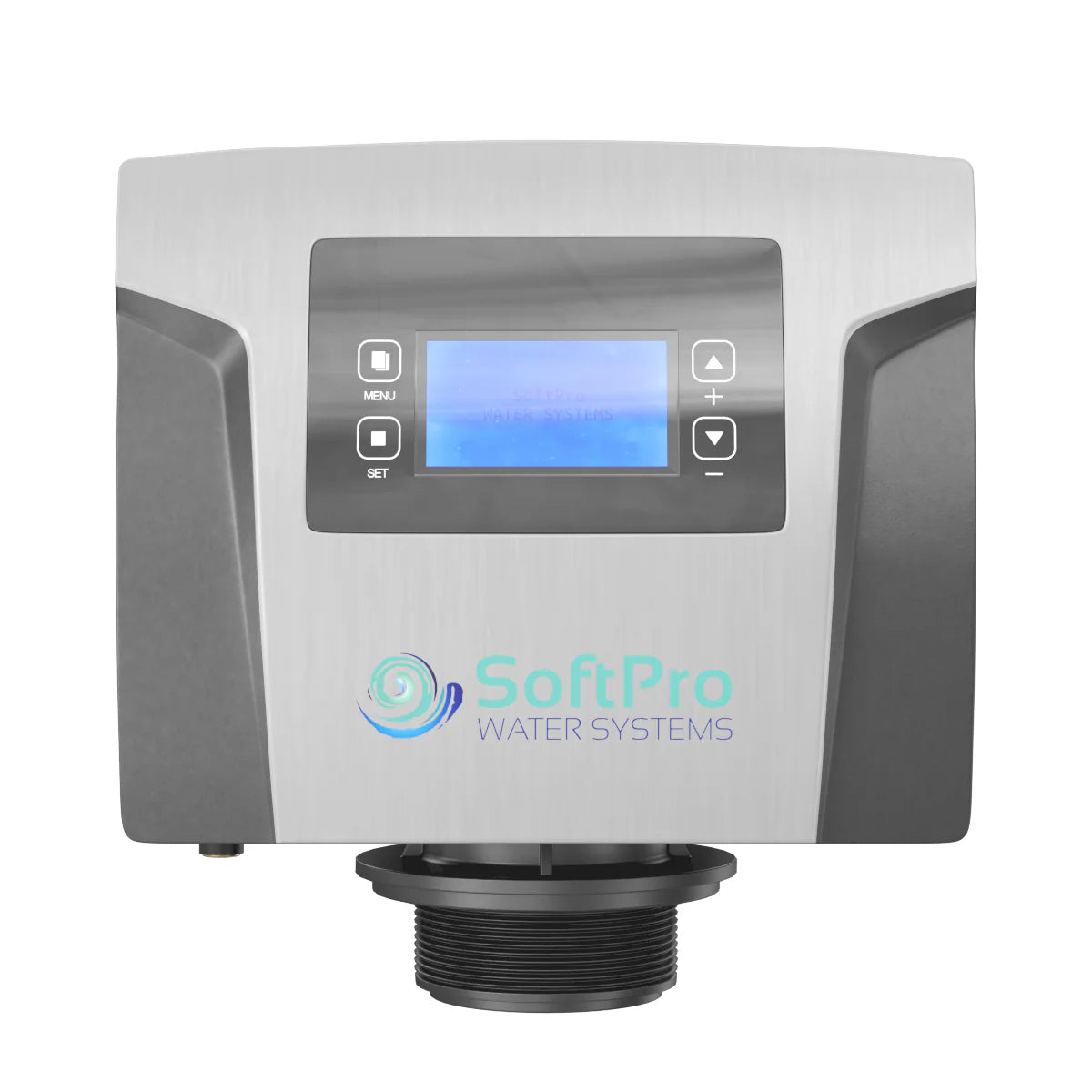
• Next-generation programmable control valve that adapts to your household's actual daily water consumption and triggers regeneration based on measured usage, not a fixed schedule
• Available in 32,000, 40,000, 48,000, and 64,000 grain capacities — the 40,000-grain option addresses a well water need that city water products rarely require

Included at No Charge: Neoprene Resin Tank Insulating Jacket — $59 Value
Every SoftPro Elite order ships with a complimentary neoprene jacket for the resin tank, while supplies last. For well water installations in garages, well houses, pump sheds, or unheated utility spaces, this jacket serves a practical purpose that goes beyond aesthetics.
• Thermal insulation reduces condensation on the resin tank surface during regeneration, preventing moisture from pooling at the base of the unit — particularly relevant in humid or seasonally cold installation environments
• Provides a protective layer against UV exposure and temperature extremes for systems installed in semi-exposed pump houses or garages
• Washable and removable neoprene construction — easy to pull off for maintenance access, rinse clean, and replace without tools
Fast, Free Nationwide Shipping
Your System Ships From the Warehouse Closest to You
• All orders process and dispatch within 1–3 business days, with full tracking information sent to your email automatically
• Nine regional warehouse locations across the country ensure your system takes the shortest available route to your delivery address
• Free shipping applies to all system purchases within the continental United States — no minimum order, no freight surcharges added at checkout
• Real people answer the phone if there's any issue with your shipment — delays, damage, or any discrepancy from what you ordered
System Protected for Life — Satisfaction Guaranteed for 60 Days
A Lifetime Warranty and a Risk-Free Trial Period
This reflects our confidence in what we build and our commitment to the homeowners who trust it.
• Sixty-day money-back guarantee with enough time to evaluate the system under your real well water conditions across multiple regeneration cycles
• Lifetime limited warranty covering the control valve and core components for as long as you own the system — transferable to a new owner if the property sells
• Honest, direct warranty support from the same team who guided your purchase — no outsourced claims handling

Iron Fouling: The Slow-Motion Failure That Destroys Well Water Softeners

Iron fouling is the most common reason well water softeners underperform within a few years of installation. It's also the most preventable.
Understanding what causes it, how to recognize it, and how the SoftPro Elite's design and bundle options address it is the most useful technical knowledge any well water softener buyer can have.

What Iron Fouling Is and How It Happens
When dissolved ferrous iron enters the resin bed alongside calcium and magnesium, it competes for exchange sites on the resin surface. During regeneration, the iron does NOT release as cleanly as calcium and magnesium do. Over many regeneration cycles, iron accumulates on and within the resin beads as iron hydroxide — a rust-like precipitate that blocks exchange sites, restricts the flow of brine through the resin bed, and progressively reduces the system's softening capacity.
A resin bed that once had 48,000 grains of effective capacity may function at 30,000 or even 20,000 grains after several years of unmitigated iron exposure.

How to Recognize Iron Fouling Before It Causes Serious Damage
• The softener regenerates noticeably more frequently than it did when first installed, without any obvious increase in household water usage
• Water hardness gradually returns — scale reappears on fixtures and dishes despite the softener running normally
• The resin has an orange or reddish-brown coloration when inspected during a brine tank cleaning
• Brine draw is slower than it should be during regeneration, indicating resin bed channeling from iron accumulation

How to Reverse Early Iron Fouling: Resin Cleaner
At the first signs of iron fouling, a liquid iron resin cleaner added to the brine tank before a regeneration cycle will dissolve accumulated iron deposits and restore a meaningful portion of the resin's exchange capacity. This is a periodic maintenance step — not a one-time fix — and works best when performed before fouling becomes severe.
Annual resin cleaner treatment is recommended for any well water softener where incoming iron levels are above 0.5 ppm even with upstream filtration in place.

How the SoftPro Elite's Design Minimizes Fouling Risk
Upflow regeneration introduces brine from the bottom of the tank and drives it upward through the increasingly depleted upper resin. This directional flow is more effective at flushing iron deposits from the upper resin bed than downflow brining.
Combined with the soft water brine tank refill feature that prevents brine solution iron loading, and the higher regeneration frequency the control valve maintains under well water conditions, the Elite's design is inherently more resistant to progressive iron fouling than a conventional downflow softener operating on the same water.