Four Systems. Independently Tested. Priced Without a Dealer's Markup in Between.
Every system below carries the same independent certifications as equipment sold through traditional dealer channels — the difference is the price, because there's no dealer, no in-home sales visit, and no service-contract revenue built into the number.
10 reviews
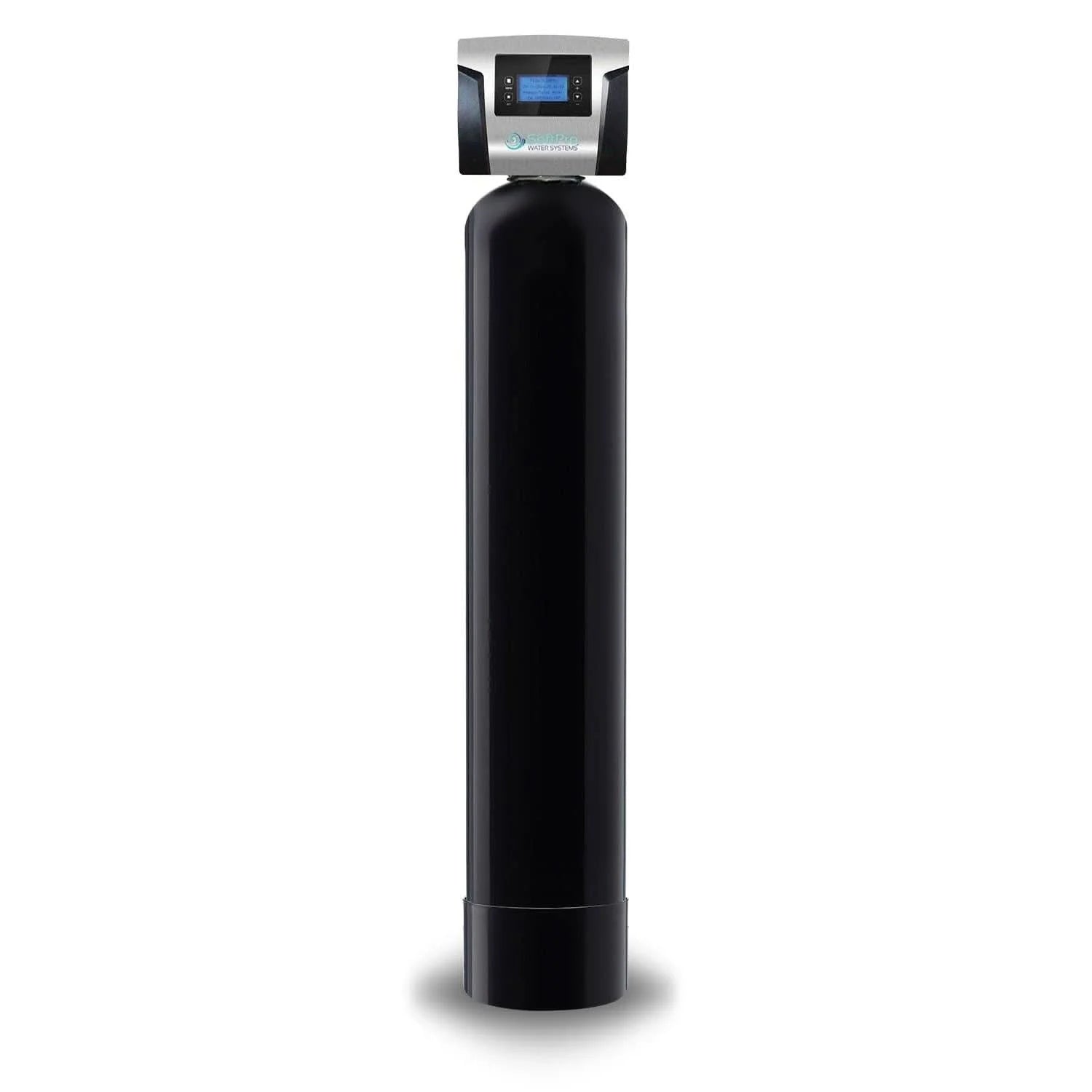
SoftPro Chlorine+ Carbon Whole House Water Filter to Remove Chlorine, Chloramine & Pesticides [City Water Filters Series]
$1,272.50$1,097.00
10 reviews
SoftPro Iron Filter - Iron Master AIO - Best Iron Filter for Well Water [Air Injected Water Filter / Katalox]
$2,036.50$1,517.00
10 reviews
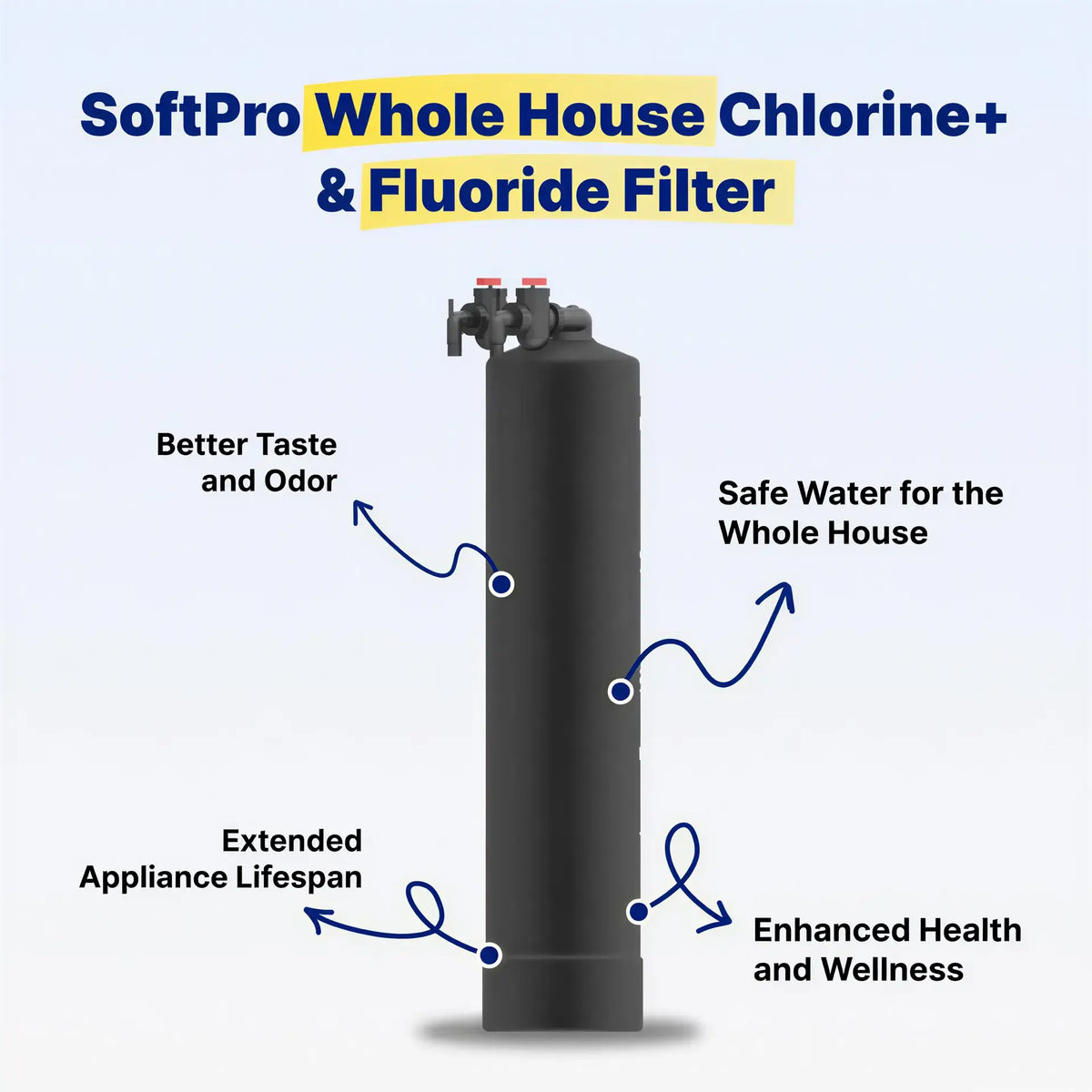
SoftPro Whole House Fluoride & Chlorine+ SUPER Filter (Catalytic + Bone Char Carbon Filter)
$1,426.50$1,267.00
10 reviews
SoftPro Catalytic Whole House Carbon Filter for Well Water
Join 100,000+ Homeowners That Have Transformed Their Water & Their Life with Home water Filter
Why One Product Rarely Solves Your Water Problem — And What Actually Does
Most homeowners buy a water treatment product the way they'd buy any other household item: they find the highest-rated option and assume it covers the problem. With whole-house water treatment, that assumption is usually wrong, and here's the reasoning why.
If you're on city water:❯
your supply has already been chemically treated before it reaches you — which solves the utility's problem (making water safe to distribute) without necessarily solving yours. Chlorine or chloramine residuals remain. PFAS compounds — only brought under federal regulation in April 2024 — may still be present below or near the new limit. Disinfection byproducts (TTHM and haloacetic acids) form when chlorine reacts with organic matter upstream. Pesticide and herbicide residue can enter the supply from agricultural runoff, often below the threshold that triggers a report but not below the threshold that affects taste or long-term exposure.
If you're on well water:❯
None of that treatment has happened at all. Whatever iron, sulfur, or hardness your specific aquifer carries arrives at your tap exactly as the ground delivered it — which is why well water problems tend to be more visible (staining, odor) but not necessarily more severe than city water's less visible chemical load.
The reason a single filter cartridge rarely resolves this:❯
Each contaminant category requires a different removal mechanism. Carbon adsorption handles chemical compounds. Air injection and oxidation handle iron and sulfur. Ion exchange handles hardness. No single technology does all three, which is why "whole-house water treatment" correctly describes a matched combination of systems, not one product.
We've been building that combination for over 30 years, across more than 100,000 installations, and we can summarize what that experience has taught us in four verifiable points:
Factory-direct pricing
Saves homeowners $500 to $1,500 versus equivalent systems sold through dealer or plumbing-contractor channels — a figure that reflects the removed cost of in-home sales visits and dealer margin, not a discount on the equipment itself.
Independent certification
Through IAPMO, WQA, NSF, ANSI, and ISO 9001 — each a third-party body with its own testing standard, so no single claim rests on our word alone.
Lifetime warranty
On every control valve and core system component — the longest standard coverage commitment in this product category, to our knowledge.
Free technical support for the life of the system
Available before purchase (to review your water test), during installation, and for as long as you own the equipment.
And Why a Municipal Report — or No Report at All — Doesn't Tell You Enough
The Case for Point-of-Entry Filtration in 2026:If you're on city water, your utility's annual water quality report tells you what was measured at the treatment plant, and whether those measurements fell within EPA limits at that point.
It does not tell you what concentration reached your specific tap after transit through your city's distribution infrastructure — infrastructure whose age varies block by block. It also does not include compounds currently under regulatory review but not yet capped.
If you're on a private well, there is no report to read. Wells carry no reporting requirement, which means hardness, iron, sediment, and biological activity in your water are entirely unknown until you test for them yourself.
The sections below explain, contaminant by contaminant, what's commonly found in each water source and which treatment technology is documented to address it — so the reasoning behind each product recommendation is visible, not assumed.
PFAS: Why "Below the Old Limit" No Longer Means Safe
PFAS — per- and polyfluoroalkyl substances — are a family of synthetic compounds that do not break down in the environment, which is the property that earned them the "forever chemical" designation. PFOA and PFOS are the two most extensively studied and most frequently detected compounds in the family.
In April 2024, the EPA established its first federal maximum contaminant levels for six PFAS compounds in public drinking water, setting the limit for PFOA and PFOS individually at 4 parts per trillion. Many municipal systems have compliance timelines that extend years beyond that ruling, meaning the regulation exists before universal compliance does.
The documented mechanism: catalytic carbon filtration can meaningfully reduce PFAS — particularly longer-chain compounds like PFOA and PFOS — through high-surface-area adsorption. Independent published testing on activated carbon shows this performance varies considerably with media age, bed volume, and PFAS chain length, with shorter-chain compounds removed far less reliably.
The SoftPro Chlorine+ Carbon Filter and the Fluoride & Chlorine+ SUPER Filter are built with this chemistry as part of their whole-house chemical-removal profile. [Fact-check note: a specific removal percentage should only be stated here if backed by this product's own NSF/ANSI 53 or 58 PFAS-reduction test data — confirm with SoftPro before publishing a number.]
Iron, Manganese, and Hydrogen Sulfide: Three Separate Problems With One Shared Cause
If you're on well water, you're likely already familiar with the symptoms even without knowing the underlying chemistry: orange staining that reappears regardless of how thoroughly it's scrubbed, a metallic taste that affects anything made with tap water, and a rotten-egg odor most noticeable when hot water runs.
Here is the reasoning that matters before choosing equipment:
These three symptoms typically come from three distinct contaminants — dissolved iron, manganese, and hydrogen sulfide — that arrive together because they share a single source, groundwater moving through iron-bearing rock and soil on its way into the well. This is why a water softener does not resolve any of the three (softeners are engineered for calcium and magnesium, a different chemical problem entirely), and why a standard carbon filter, designed for chlorine and organics, is not rated for the concentrations a well can produce.
How the SoftPro Iron Master AIO addresses this:
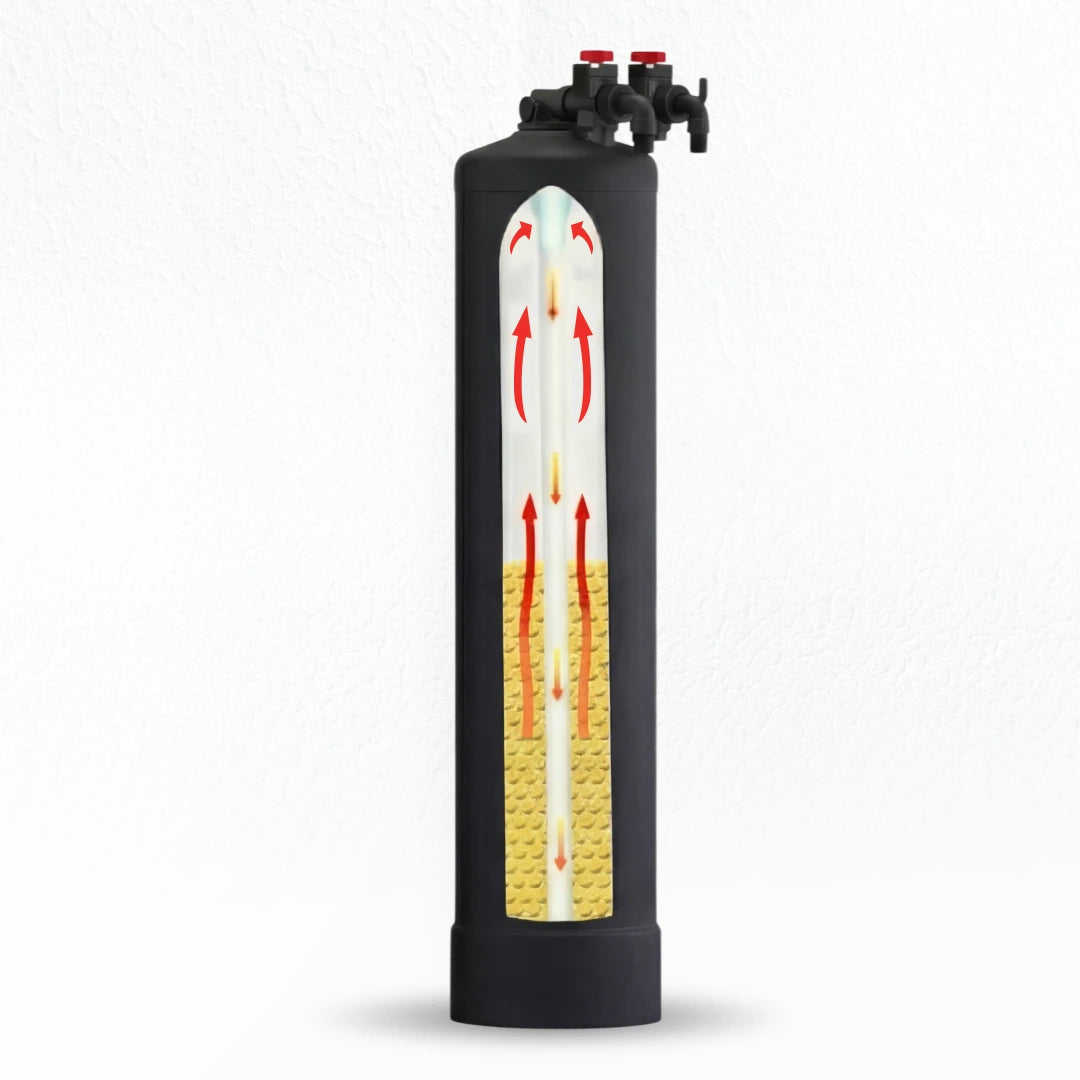
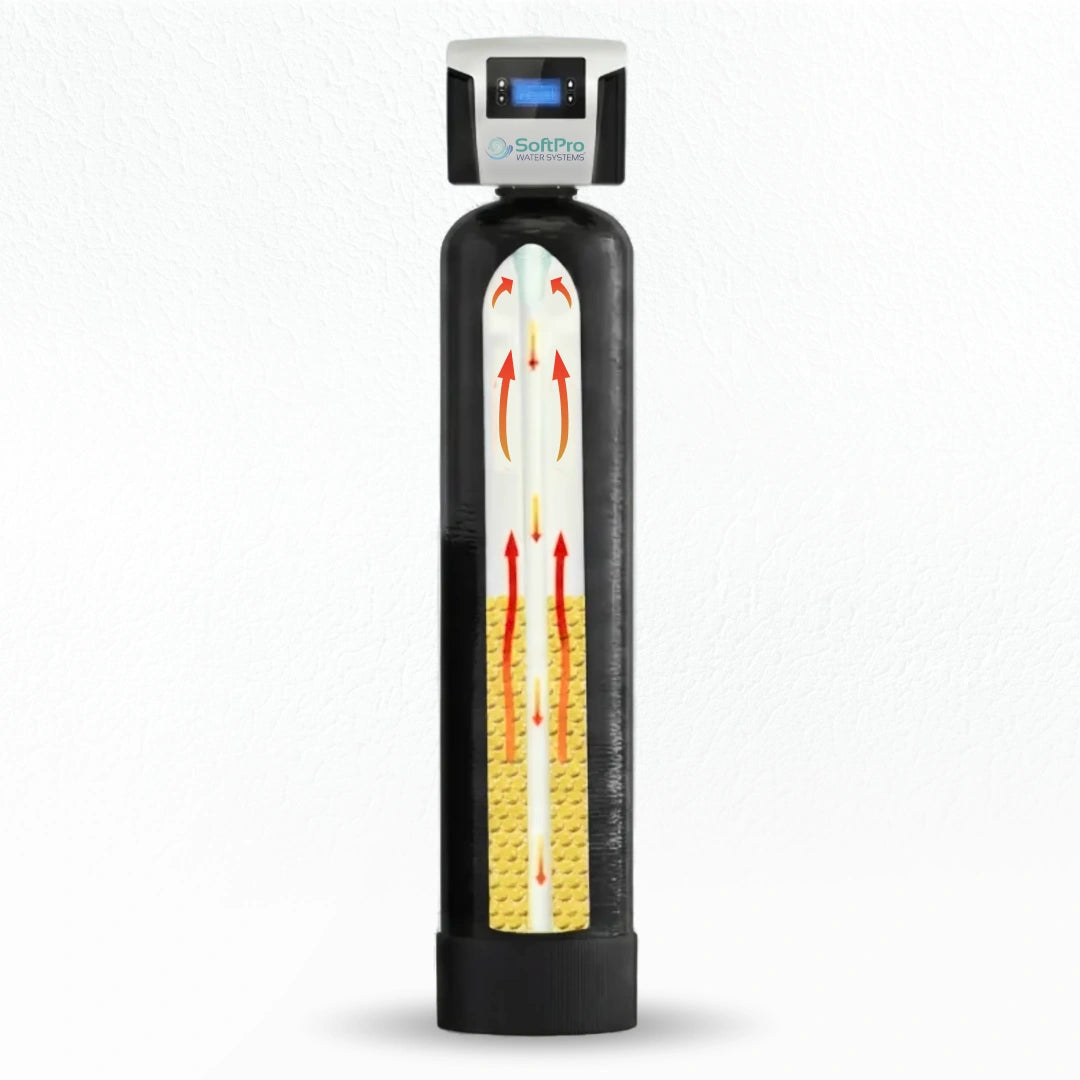
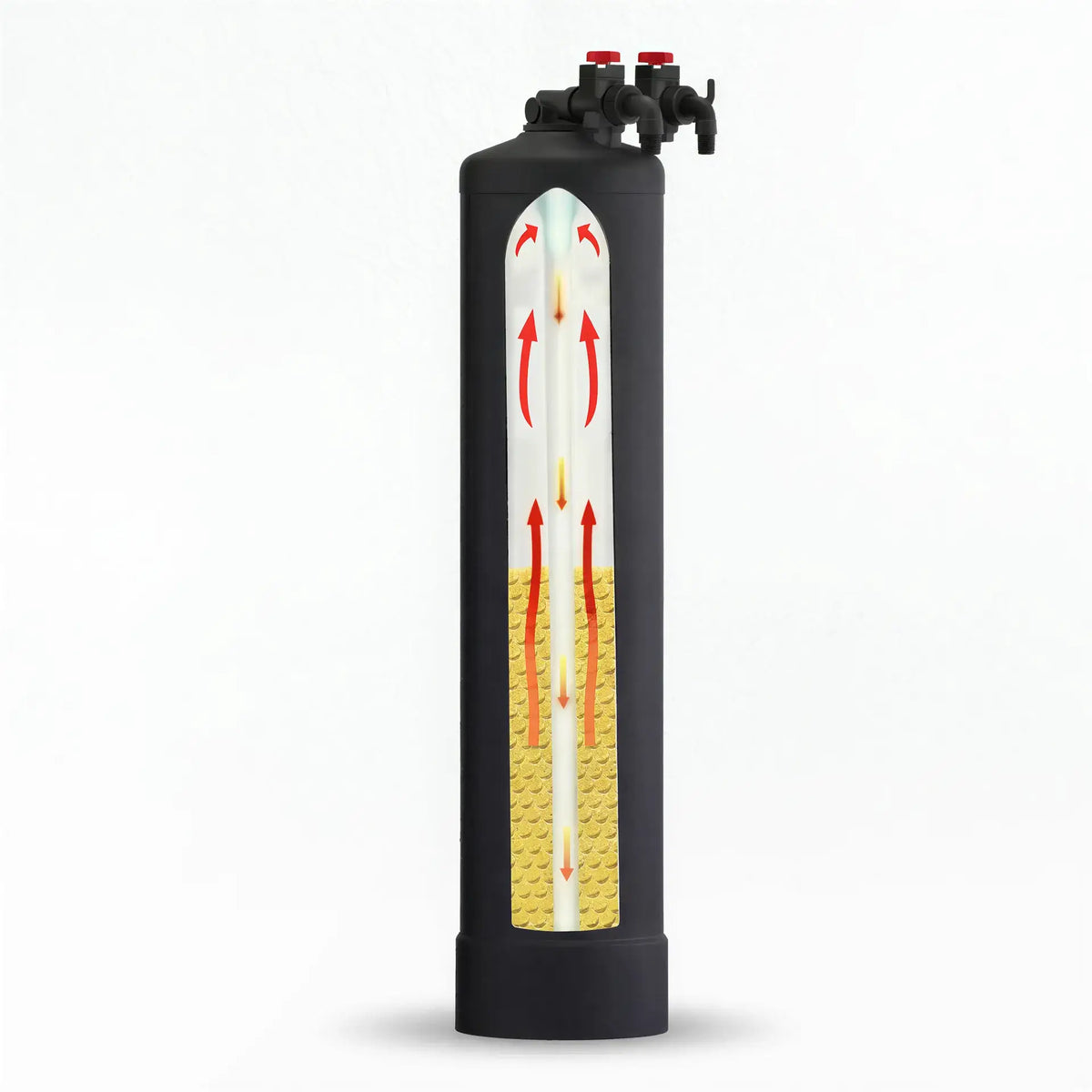
And why the mechanism matters: Most iron filtration on the market relies on chemical dosing — chlorine or potassium permanganate — which introduces an ongoing cost and a dependency: run out of the chemical, and the iron problem returns immediately. The Iron Master AIO uses a different, chemical-free mechanism. It maintains a pocket of compressed air at the top of the tank. Every time water enters the system, it passes through that air pocket, and the oxygen present oxidizes dissolved iron and manganese on contact — converting them from dissolved, invisible compounds into solid particles. A bed of Katalox media then physically captures those particles before the water reaches any fixture. An automatic overnight backwash flushes the captured material to drain and recharges the air pocket for the next cycle. The result: no cartridges to replace, no chemicals to reorder, and no maintenance step a homeowner has to remember.
What the system is independently rated to handle:
Iron up to 30 ppm (dissolved, particulate, and colloidal forms)
Manganese up to 7 ppm
Hydrogen sulfide, at concentrations responsible for sulfur odor
A modest pH increase as a byproduct of the oxidation process — a secondary benefit for households with acidic well water already corroding copper pipe
Why this system, specifically, rather than the alternatives homeowners typically consider first:
Greensand filtration requires ongoing potassium permanganate dosing — an added recurring cost every chemical-free system avoids by design. Birm media is only effective above pH 6.8, which excludes a meaningful share of naturally acidic wells. Chemical chlorination handles high iron loads but produces disinfection byproducts that then require a second filtration stage to remove. Air-injected Katalox filtration covers a wider iron range across a wider pH range, with no consumable to purchase.
The single decision that determines whether this system performs as rated:
Tank sizing is based on your well pump's sustained flow rate, not your home's bathroom count — a distinction worth stating plainly because it's the most common sizing error. Undersizing produces a pressure drop the moment two fixtures run simultaneously. Oversizing means the backwash cycle can't move enough water to properly clean the media bed, and performance degrades gradually, without an obvious warning sign, until the original symptoms return.
How to determine your number before ordering — not after:
Shut off every tap in the home. Locate an outdoor spigot near the pressure tank. Run it fully open for 30 seconds to let flow stabilize. Time how long it takes to fill a 5-gallon bucket. Divide 5 by that time in seconds, then multiply by 60.
That figure is your GPM.If you're uncertain of your number, or your pump may not be delivering its original rated output, we recommend sending us your details before ordering. Confirming sizing in advance is a five-minute conversation; correcting an undersized or oversized installation after the fact is not.
What arrives at your door:
Iron Master AIO tank in your chosen size (1.0, 1.5, or 2.0 cubic feet), Katalox filtration media pre-loaded and ready to commission, a 1-inch programmable control valve with 4-line LCD display and electronic touchpad, an air injection assembly built directly into the control valve, standard plumbing connections and bypass valve hardware, a full printed install guide plus a QR-linked video walkthrough, and direct phone access to our well water support team. Optional at checkout: quick-connect flexible hose kits (3/4" and 1") and a weather-resistant valve cover.
Installation sequence, if pairing with a softener — this order is not optional and here's the reason why :
Well pump → pressure tank → Iron Master AIO → softener → household supply. Iron must be removed before water reaches softener resin. Installed in the reverse order, untreated iron fouls the resin bed the softener depends on, degrading its softening capacity well before any external symptom appears.
What ownership involves, stated plainly rather than implied:
Once a year: a visual inspection of connections for moisture, confirmation the bypass valve moves freely, and a check of the display for fault codes — under fifteen minutes. Every few months: confirm the backwash cycle is completing, with active drain flow for the full 15–20 minutes; a yellow-brown or mildly sulfurous discharge during that window is expected, not a fault. Annually: retest your well water, since well chemistry shifts over time and a change in sulfur, pH, or contaminant profile may mean the system needs reconfiguring rather than servicing. Media life runs 3 to 10 years depending on actual iron and sulfur load; a gradual return of odor or staining is the expected signal that replacement is approaching, not an unexpected failure. A 5-micron sediment pre-filter installed upstream measurably extends media life if your well water carries any turbidity.
One limitation worth stating directly, because omitting it would be misleading:
iron bacteria — a distinct problem from dissolved iron, identifiable by a slimy reddish residue and a foul smell — is not resolved by filtration alone. If bacteria are established in the well, it requires shock chlorination first; otherwise a new filter will be recontaminated within weeks.
Professional-Grade Solutions
Real Results Our Customers See In Just Moments
Soft, Clean Water Changes Everything!
BeforeAfter
BeforeAfter
BeforeAfter
We revolutionized the water softener industry. People noticed.
HERO SECTIONS
PRODUCT SECTIONS
SOCIAL PROOF
Chlorine Is the Symptom You Notice. Its Byproducts Are the Reason to Look Closer.
The most immediately noticeable benefit of a whole-house carbon filter is the disappearance of chlorine's taste and odor — most homeowners notice this within days.
But there's a second-order effect worth understanding: when chlorine reacts with naturally occurring organic matter in source water during treatment, it forms disinfection byproducts — principally total trihalomethanes (TTHM) and haloacetic acids.
Both are EPA-regulated, at concentrations considered acceptable for public health rather than eliminated entirely.A catalytic carbon bed addresses both sides of this: it removes the residual chlorine before it can continue forming these compounds, and it removes the compounds that have already formed.
For the growing share of U.S. cities that have shifted to chloramine-based disinfection, this distinction matters — standard granular activated carbon is measurably less effective against chloramine at normal household flow rates, while catalytic carbon's different surface chemistry is not.
A Contaminant That Doesn't Care Whether Your Water Comes From a City Main or Your Own Well
Agricultural chemical residue enters both municipal surface-water sources and private well aquifers the same way — through soil filtration and runoff — which means neither water source is inherently protected from it.
Many of these compounds pass through conventional municipal treatment at trace concentrations that sit below current regulatory thresholds, which is not the same as being absent.
Activated carbon adsorption provides broad-spectrum reduction here. Catalytic carbon's high surface area captures pesticides, herbicides.
The wider category of volatile organic compounds, regardless of whether your water originates from a treatment plant or an aquifer.
Our Most Popular Whole House Water Filtration Systems
Independently certified, factory-direct, and built for city and well water homes across America.
10 reviews
SoftPro Chlorine+ Carbon Whole House Water Filter to Remove Chlorine, Chloramine & Pesticides [City Water Filters Series]
$1,272.50$1,097.00
10 reviews
SoftPro Iron Filter - Iron Master AIO - Best Iron Filter for Well Water [Air Injected Water Filter / Katalox]
$2,036.50$1,517.00
10 reviews
SoftPro Whole House Fluoride & Chlorine+ SUPER Filter (Catalytic + Bone Char Carbon Filter)
$1,426.50$1,267.00
10 reviews
SoftPro Catalytic Whole House Carbon Filter for Well Water
The Contaminant That Damages Every Other System You Install
Sediment — suspended sand, clay, silt, rust scale from aging pipes, and fine organic matter — is a physical rather than chemical contamination category.
It's the one most likely to shorten the working life of every other treatment component installed downstream of it if left unaddressed.
A dedicated 5-micron sediment pre-filter installed ahead of primary treatment equipment protects carbon media, softener resin, and reverse osmosis membranes from the physical fouling that reduces their effective service life.
For well water specifically, pump disturbance and seasonal changes in the water table can introduce fine particulate without warning, which is why a sediment pre-filter is typically recommended as a first-line addition rather than an optional extra for any well showing visible turbidity.
The One Input That Determines Whether Your System Performs as Rated
Grain capacity, for a softener, is a function of three measurable inputs: household size, water hardness, and daily usage. Our free calculator walks through all three in under two minutes and returns a specific recommendation — removing the guesswork that leads to the two most common sizing mistakes: undersizing (frequent regeneration, reduced capacity) and oversizing (unnecessary cost).
Why Ion Exchange Remains the Standard — and What's Different Between a City and a Well Softener.
Hard water — water carrying elevated dissolved calcium and magnesium — affects the majority of American households, and its effects are visible and cumulative: white scale on fixtures and shower glass, spotted dishes after washing, soap and shampoo that fail to lather properly, dry skin after bathing, and accelerated internal wear in water heaters, washing machines, and dishwashers as mineral scale builds on heating elements over time.
Ion exchange resolves this directly:❯
As water passes through a resin bed, dissolved calcium and magnesium are exchanged for sodium ions, producing water that neither forms scale nor interferes with soap chemistry.
The SoftPro Elite and ECO systems:❯
Apply this same principle differently, because city and well water present different engineering requirements. City water softeners operate in a stable, predictable environment — known hardness, no iron present. Well water softeners must additionally accommodate iron loading on the resin bed, more frequent regeneration cycles, and — in most cases — dedicated iron filtration installed upstream to prevent resin fouling.
SoftPro Elite HE — premium upflow ion exchange, using 25–30% less salt per cycle than conventional downflow designs. Available in 32K, 40K, 48K, and 64K grain capacities for city and well water.
SoftPro ECO™ — metered demand regeneration in a 3/4" format, regenerating based on measured water usage rather than a fixed timer. Available in 32K, 48K, and 64K grain for city and well water.
Both carry NSF/ANSI 44 certification, WQA Gold Seal, IAPMO certification, and ISO 9001 manufacturing quality certification.
Both include 48-hour battery-free capacitor memory, Vacation Mode, Smart Clean auto-sanitize, and metered demand regeneration.
For well water installations, correct sequencing is a technical requirement, not a preference:❯
Sediment pre-filter → iron filter (if iron is present) → water softener. Iron reaching the softener without pre-treatment causes progressive iron fouling of the resin — a gradual accumulation of iron hydroxide that blocks exchange sites and reduces softening capacity well before the reduction becomes noticeable at the tap. Correct sequencing protects the resin investment and extends functional softener life by years.
The Reasoning Behind the Price — and the Proof Behind the Claims
100,000+ Households. 30+ Years. Lifetime Warranty. A Support Team You Can Reach by Phone.
30+ Years of Experience
Founded by Craig Phillips, known industry-wide as "The Water Guy," with three decades of residential water treatment experience informing every product decision. The design priority throughout has been what performs reliably in real homes, not what tests well in a controlled lab environment.
IAPMO Certified
Confirms compliance with the plumbing safety standards referenced in U.S. residential building codes, relevant to any installation requiring a permit or inspection.
WQA & NSF Certified
WQA certification requires accredited testing and ongoing manufacturing compliance documentation with periodic re-evaluation; NSF certification independently verifies material safety and performance claims rather than relying on self-reported specifications
ISO 9001 Manufacturing
Confirms that production processes, design controls, and quality assurance procedures at the manufacturing facility meet international standards on an ongoing, audited basis — not as a one-time certification event.
Real Technical Support
Our support team includes specialists in city water treatment, well water treatment, iron filtration, and chemical filtration, providing pre-purchase water test review, phone-guided installation, and long-term maintenance support at no charge for the life of the system.
Free Sizing Calculator
Walks through household size, water hardness, and daily usage to confirm correct grain capacity before purchase, removing the incentive (and the guesswork) that leads to overselling or underspecifying elsewhere in the industry.
What Customers Report After Installation
JULIE M. - FLORIDA
Verified Customer
After we installed the Softpro Elite I noticed a significant difference in the house water quality.
DANIEL R. - TEXAS
Verified Customer
I just wanted to say thank you for your excellent products and service over the past 12 years.
DAN T. - SOUTH CAROLINA
Verified Customer
Great customer service before and after my softener purchase!
DENISE C. - NEW HAMPSHIRE
Verified Customer
Easy to install. Jeremy helped in making the right purchase!
ROY P. - CALIFORNIA
Verified Customer
Very impressed and satisfied with SoftPro's products and customer service!
Frequently Asked Questions
The Questions Worth Answering Before You Order — Not After
What's the best whole house water filter for city water?
The answer depends on your primary concern. For chlorine, chloramines, PFAS, pesticides, herbicides, and chemical taste and odor removal at every outlet, the SoftPro Chlorine+ Carbon Filter ($819) delivers whole-house catalytic carbon filtration without electricity, chemicals, or cartridge replacements. If fluoride reduction is also a priority, the Fluoride & Chlorine+ SUPER Filter ($1,019) adds bone char media on top of the carbon filter's full contaminant profile. Both use upflow design and maintain strong water pressure throughout the home.
What's the best whole house water filter for well water?
This requires a diagnosis-first approach rather than a single recommendation. If iron, manganese, and hydrogen sulfide are the primary problem, the Iron Master AIO addresses all three through air injection oxidation. If sulfur odor at lower concentrations, organic compounds, and agricultural residue are the primary concern, the Catalytic Well Water Carbon Filter with Centaur media is the appropriate system. If both are present, the Iron Master AIO installed upstream, followed by the carbon filter downstream, addresses the complete profile. Where hardness is also present, a softener at the end of the sequence handles what the filters leave behind. We recommend sharing your water test results with our team before ordering so we can size and configure correctly for your specific conditions.
Do I need both a water filter and a water softener?
That depends on your water. Softeners remove dissolved calcium and magnesium — the hardness minerals responsible for scale, spotted dishes, dry skin, and appliance wear. Whole house filters remove chemical contaminants — chlorine, chloramines, PFAS, pesticides, iron (via iron filter), and sulfur (via carbon or iron filter). Neither system performs the other's function. Where water is both hard and chemically contaminated — a common combination — both systems working together address the full profile. Install the filter upstream of the softener so chemically treated water reaches the resin, rather than untreated chlorine that degrades resin over time.
What is a sediment pre-filter, and do I need one?
A sediment pre-filter is a filtration stage — typically a 5-micron housing with replaceable cartridges — that removes suspended particulate before water reaches your primary treatment system. On city water, it extends carbon media's effective service life. On well water, it's particularly important ahead of UV systems (turbid water blocks UV disinfection), iron filters (particulate iron loads the Katalox media), and carbon filters (clay and silt reduce performance over time). Visible cloudiness, seasonal turbidity, or fine sediment at your aerators are the specific signals that indicate a sediment pre-filter should be your first investment.
How do I know what size system I need?
For water softeners, household size and water hardness determine grain capacity — our free online calculator at calc.softprowatersystems.com walks through this in under two minutes. For backwash-based filters (the Iron Master AIO and the Catalytic Well Water Carbon Filter), your well pump's sustained GPM determines the correct size, independent of bathroom count — measure it using the 5-gallon bucket method before ordering. For passive city water filters, the 1.5 CUFT configuration on the Chlorine+ and SUPER Filters handles 1 to 6 bathrooms under normal residential demand.
Does a whole house carbon filter reduce water pressure?
Not meaningfully, under normal residential demand and correct sizing. SoftPro's city water upflow carbon filters are engineered to maintain strong pressure with multiple simultaneous outlets running. The Iron Master AIO uses a 1" ported high-flow valve specifically to minimize pressure drop under peak demand. If pressure is a specific concern for your installation, we recommend confirming your incoming supply pressure and discussing sizing with our technical team before ordering.
Can I install a whole house filter myself, or do I need a plumber?
Most SoftPro systems are designed for installation by homeowners with basic plumbing skills — comparable to the competence required to replace a shut-off valve or install a new fixture. Systems ship with bypass valves, installation guides, and access to video walkthroughs. Our technical support team is available by phone during business hours to guide any step in real time. Professional installation by a licensed plumber is also an option and does not affect the system warranty either way.
Will this actually resolve the sulfur smell, or only the staining?
Both. Hydrogen sulfide removal occurs through the same air injection process that handles iron and manganese. Most homeowners report the odor gone within days of installation.
What if the problem is iron bacteria, not just dissolved iron?
This is a distinct issue that filtration alone does not resolve. Iron bacteria — identifiable by a slimy reddish residue and a foul odor — requires the well to be shock-chlorinated first; without that step, a newly installed filter will be recontaminated within weeks.
What if I have both iron and hardness?
This is a common combination. Install the Iron Master AIO first in the sequence, softener second — iron must be addressed before water reaches softener resin, or the resin will foul. Our team can help size both systems together.
What This System Asks of You ?
An Honest Description of Long-Term Ownership — Not a Marketing Simplification
Auto-backwash design makes this one of the lower-maintenance well water treatment systems available, but "low-maintenance" should be defined specifically rather than left vague. Here is what ownership actually requires.
Once a year — Visual Inspection: Check all inlet, outlet, and drain connections for signs of moisture or drips. Confirm the bypass valve operates freely. Check the control valve display for fault codes. The full inspection takes under fifteen minutes.
Every few months — Backwash Verification: Confirm the system is completing backwash cycles correctly. During a scheduled backwash, the drain line should show active flow for the full 15–20 minute duration. Discharge that appears yellow-brown, or carries a mild sulfur character, is expected — particularly with elevated H₂S — and indicates the system is successfully flushing captured contaminants.
Annually — Well Water Retesting: Well water chemistry changes over time. Annual testing for hydrogen sulfide, pH, and primary contaminants of concern confirms whether the system remains correctly sized and configured for current conditions. A significant increase in H₂S, a change in organic loading, or a pH shift can indicate that the backwash frequency or media condition needs reassessment.
Media Replacement, 3 to 10 Years: Centaur catalytic carbon media's service life depends on contaminant loading, household consumption, and backwash effectiveness — which is why the range is wide rather than a single figure. Moderate H₂S and low organic loading can reach 8 to 10 years; heavy sulfur and high organic contamination can exhaust media in 3 to 5. A gradual return of sulfur odor, or a reduction in water quality, is the expected signal that replacement is approaching — not an unexpected failure.
How to extend media life: A sediment pre-filter installed upstream of the carbon filter significantly extends media life on well water carrying fine particulate or turbidity, because sediment accumulation in the carbon bed increases backwash load and reduces effective adsorption surface. A 5 or 10 micron sediment filter is particularly recommended for wells in clayey soils or with seasonal turbidity.
Traditional residential water treatment is typically sold through dealer networks:
Service contracts, and in-home consultations — a distribution model whose cost is reflected directly in the final price. A system that costs roughly $400 to manufacture, and could be sold factory-direct for around $800 with a lifetime warranty, frequently sells for $2,000 to $3,000 through a traditional dealer channel. The difference is not additional value — it's dealer margin, installation markup, and the ongoing service-contract revenue the dealer model is built to generate.
SoftPro's factory-direct model removes each of those layers. The equipment is built to the same specifications as dealer-channel systems, certified by the same independent organizations, and warranted for the same lifetime commitment — priced according to actual production and support cost rather than what a sales-driven channel can extract.
Installation Overview:
What a Correct Point-of-Entry Installation Actually Requires
The Catalytic Well Water Carbon Filter installs at the main point of entry on the well supply line, typically between the pressure tank and the household distribution lines — a placement chosen specifically so that every fixture, appliance, and tap receives treated water without exception, rather than treating water at a single point of use.
v
A drain connection is required for backwash discharge, the periodic cycle that reverses flow and carries accumulated material from the media bed to drain.
Standard installation sequence, and why order matters:Well pump → pressure tank → this carbon filter → (Iron Master AIO first, if iron is present) → water softener → household distribution. If iron is present and not addressed first, it loads and fouls the carbon media before the carbon filter can perform its intended function.
What a standard installation involves:
Locating the main supply line after the pressure tank — the correct installation point for point-of-entry treatment
Shutting off the well pump at the breaker and releasing pressure from the supply line before cutting in
Connecting inlet and outlet to the supply line using included connection hardware (quick-connect flex line add-ons available)
Installing the bypass valve, which allows the filter to be isolated for media service without interrupting the household water supply
Connecting the drain line from the control valve to a laundry drain, floor drain, or utility sink
Plugging the control valve into a standard 110V outlet, required for backwash cycle control
Programming the backwash schedule using the 4-line LCD display — our team can guide this step by phone
Running an initial manual backwash to condition the fresh media bed and clear fine carbon dust before normal service begins
Most installations are completed in three to four hours by a homeowner with basic plumbing skills. Our technical support team is available by phone during business hours to guide any step, including backwash schedule programming specific to your well pump's GPM and your water's H₂S concentration.
Choosing a selection results in a full page refresh.

![SoftPro Chlorine+ Carbon Whole House Water Filter to Remove Chlorine, Chloramine & Pesticides [City Water Filters Series]](http://myhomewaterfilter.com/cdn/shop/files/SoftPro_Whole_House_Carbon_Filter_Chlorine_70aedb15-14a1-4eab-9c70-260f47a6f6f4.webp?v=1769133629&width=140)


![SoftPro Iron Filter - Iron Master AIO - Best Iron Filter for Well Water [Air Injected Water Filter / Katalox]](http://myhomewaterfilter.com/cdn/shop/files/SoftPro_AIO_Iron_Master_-_Best_Whole_House_Iron_Filter.webp?v=1769133505&width=140)


 1-866-278-4130





 It does not tell you what concentration reached your specific tap after transit through your city's distribution infrastructure — infrastructure whose age varies block by block. It also does not include compounds currently under regulatory review but not yet capped.
 If you're on a private well, there is no report to read. Wells carry no reporting requirement, which means hardness, iron, sediment, and biological activity in your water are entirely unknown until you test for them yourself.
 The sections below explain, contaminant by contaminant, what's commonly found in each water source and which treatment technology is documented to address it — so the reasoning behind each product recommendation is visible, not assumed.