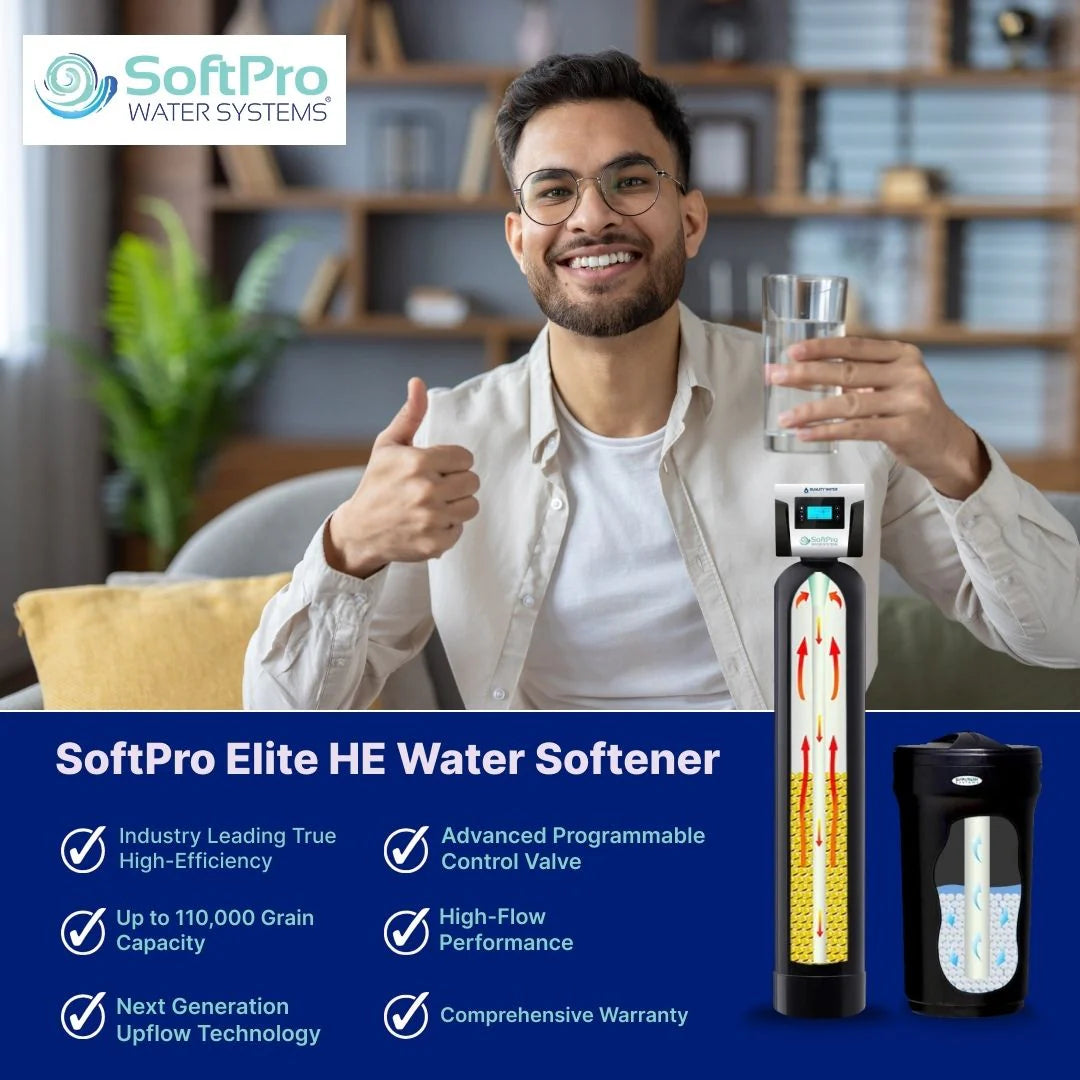
SoftPro ECO™ City Water Softener - Best Water Softener Systems for City Water
$1,028.65
$967
Save 6%
In stock. Shipped within 1-3 days.
check
FACTORY-DIRECT SAVINGS
check
BUILT IN USA
check
EASY INSTALLATION
check
FREE SHIPPING
check
LIFETIME WARRANTY
check
60-DAY MONEY BACK GUARANTEE
Product Addons
Product title
$19.99
Product title
$19.99
Product title
$19.99
32000
32000
48000
64000
Softener ONLY
Softener ONLY
Gold (Whole House Chlorine+)
Gold+ (Whole House Chlorine+ & Fluoride Removal)
100% Secure Checkout
Guaranteed Secure
06 Jul 2026
Order Received
08 Jul 2026
Order Shipped
10 Jul 2026
Estimated Delivery
100,000+ Homes Upgraded. Countless Plumbers Quietly Devastated.
3 Steps. Whole House. Zero Excuses.
You've been showering in the same sketchy water as your pipes. Yeah. Think about that for a second. Here's how you fix it and no, it's not complicated.
1
Claim Your Upgrade
Stop drinking what the pipes left behind. A few clicks. One decision. Your whole house transformed. We made checkout stupid-easy so you've got no excuse left.
2
It Ships Fast. Like, Really Fast.
Order today, and we're already boxing it up. Out the door in 2 days flat with tracking so you can watch it haul across the country toward your house like the hero it is.
3
Spa Water. Your House. No Hard Water Drama.
Install it. Turn it on. Forget it ever wasn't there. No more crusty faucets, no more skin that feels like sandpaper, no more water that's been through God knows what.
Introducing the SoftPro ECO — A Smarter Answer to Hard City Water
Your city's been sending water to your tap. What's actually in it? Hard minerals. Chemicals. The kind of stuff that wrecks your pipes, trashes your appliances, and leaves your skin feeling like you toweled off with sandpaper.
Here's the thing most homes don't realize.
Your city water meets every EPA safety standard. Great. But it's also hauling dissolved calcium and magnesium that got picked up LONG before it hit the treatment plant. No municipal process removes these minerals. They arrive at your tap unchanged — and they quietly make everything harder.
Soap that won't foam right. Film on glasses straight out of the dishwasher. Skin that feels tight after a shower. A water heater working twice as hard as it should. Sound familiar?
The SoftPro ECO™ was designed for the household that wants that problem GONE — permanently, affordably, and without the complexity of a system loaded with features you'll never use.
It's a whole-house ion exchange water softener purpose-built for standard city water connections. Hook it to your 3/4" supply line, program your water hardness, add salt, and every tap in your home runs soft from that day forward. Done.
What Makes the ECO Worth Your Attention
What makes the ECO genuinely worth considering in a crowded market is the combination of honest performance and practical value.
The digital control valve manages every regeneration cycle based on your household's REAL water consumption — not a preset clock that wastes salt regardless of what you actually used. The system uses less salt than old-style timer softeners, requires almost no day-to-day attention once installed, and comes backed by a warranty and satisfaction window that most systems at TWICE the price can't match.
City Water's Hidden Problem Goes Beyond Hardness
Municipal water is treated with chlorine and chloramines to keep it safe through miles of distribution pipes. Those disinfectants do their job — but they also reach YOUR home, where they affect how water tastes, how it smells from the tap, and how your skin and hair feel after a shower.
A softener on its own removes mineral hardness. It does NOTHING about the chemical treatment layer that city water arrives with.
That's the reasoning behind the Gold and Gold+ bundle options. Both add a whole-house filtration system to the ECO softener — so instead of solving one problem and leaving another, you address BOTH in a single installation.
Gold Package — Softener + Chlorine+ Carbon Filter
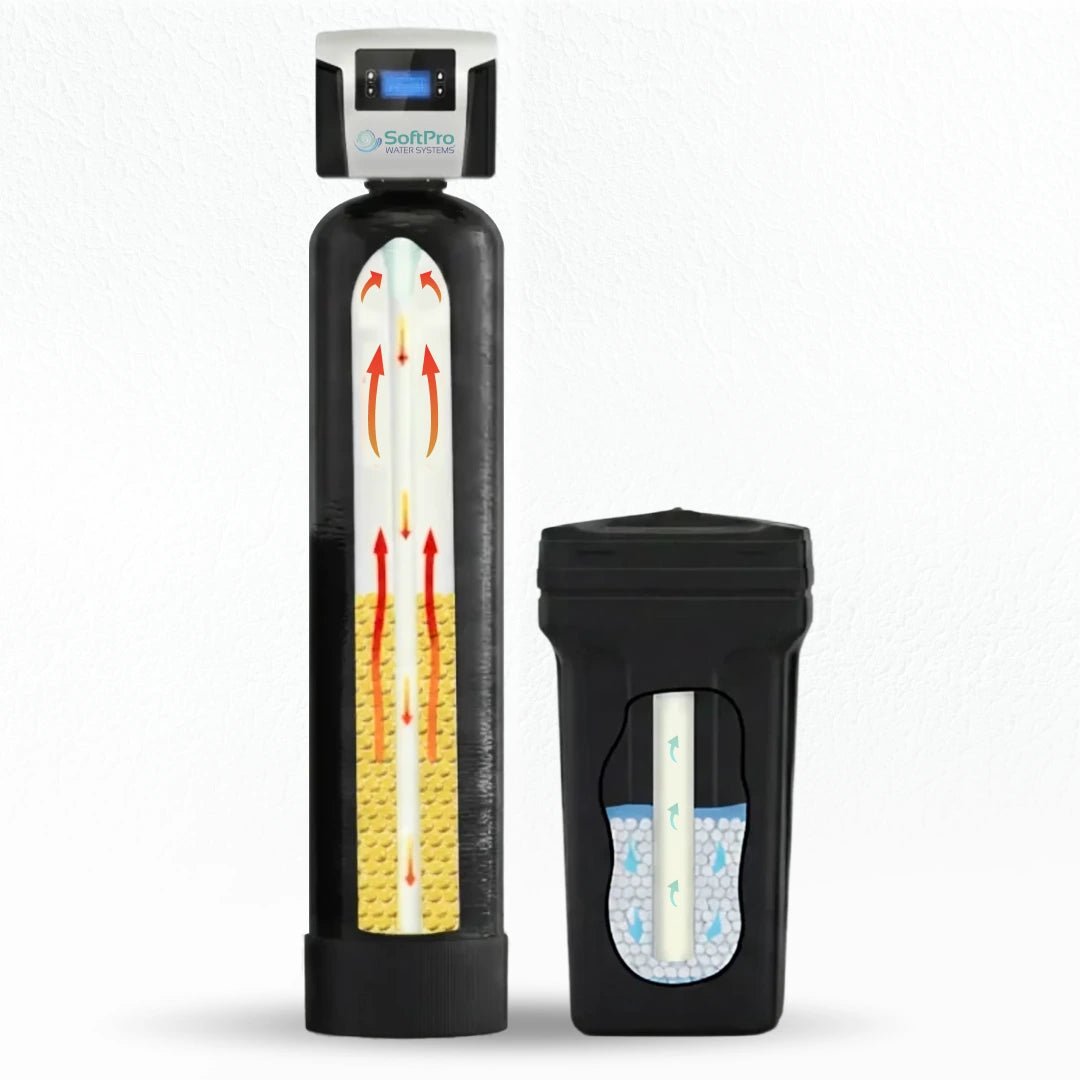
The Gold bundle adds a high-flow upflow catalytic carbon filter to the ECO system. Catalytic carbon has a more reactive surface structure than standard granular activated carbon, which gives it measurably higher capacity for removing chloramines — the disinfectant used in a growing number of city water supplies that standard carbon filters struggle to reduce effectively.
The result? Whole-house water that's free from hardness minerals AND from the chlorine taste and chemical odor that makes municipal tap water unpleasant even after softening.
Gold+ Package — Softener + Chlorine+ & Fluoride SUPER Filter
The Gold+ bundle goes a step further. It replaces the standard carbon filter with a dual-media SUPER Filter that combines catalytic carbon with food-grade bone char.
Bone char is one of the FEW materials with a proven ability to reduce fluoride at a whole-house scale — its calcium-rich porous structure binds fluoride ions through a process that activated carbon alone can't replicate.
For families where fluoride reduction is a priority, or who simply want the broadest possible protection from a single system, Gold+ delivers that without requiring separate under-sink units at individual taps.
What Each Package Actually Delivers
Softener Only — What It Delivers
• Calcium and magnesium removed from every gallon entering the home — scale prevention at the source
• Softer, cleaner feeling skin and hair after every shower without changing any products
• Spot-free dishes and glasses out of the dishwasher, every cycle
• Brighter laundry and noticeably reduced detergent consumption per wash
• Longer appliance life and lower water heating costs as scale stops forming inside pipes and tanks
Gold — Soft Water + Chlorine and Chemical Removal
• Everything in the Softener Only package
• Whole-house removal of chlorine, chloramines, and disinfection chemical odors via catalytic carbon
• Improved taste and smell at every faucet and kitchen tap throughout the home
• Reduced chemical exposure during showers and bathing — especially beneficial for households with children
Gold+ — Soft Water + Chlorine + Fluoride Reduction
• Everything in the Gold package
• Whole-house fluoride reduction through bone char media
• Broader removal of VOCs, trace organic compounds, and agricultural chemical residues
• Drinking and cooking water quality at every tap that goes beyond what a softener and standard carbon filter can achieve together
Soft Water. Re-Invented for Homes That Want Performance Without Overcomplication.
We're So Confident, We'll Take It Back.
No fine print gymnastics. No "terms and conditions may apply" runaround. If your water isn't softer, cleaner, and straight-up better send it back. Every penny returned. No hard feelings. 6 whole months. That's not a guarantee. That's a dare.
Soft Water. Re-Invented for Homes That Want Performance Without Overcomplication.
The SoftPro ECO™ Delivers What Most Households Actually Need
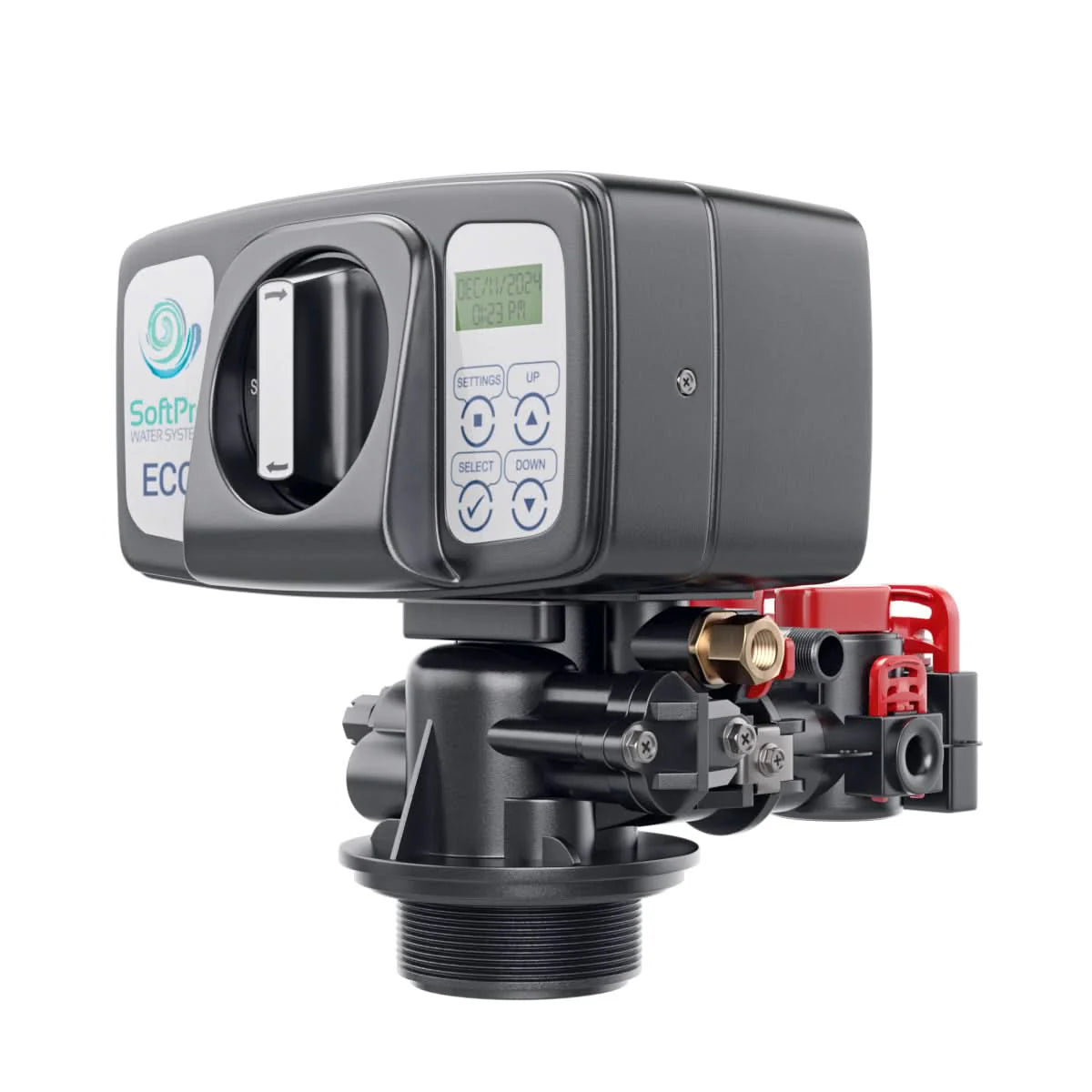
Consistent whole-house soft water, smart salt management, and reliable long-term operation — in a system that doesn't require a plumber to understand. • Industry-tested programmable control valve with demand-based regeneration, permanent settings memory, and 48-hour battery-free backup
• Next-generation digital management that reads your household's ACTUAL daily water consumption and regenerates only when genuinely needed — not on a fixed schedule that wastes salt
• Available in 32,000, 48,000, and 64,000 grain capacities to match homes from compact two-person apartments to large family households on hard city water
What Makes It ECO — And Why That Matters for Your Budget
The name ECO isn't marketing shorthand for entry-level. It describes how this system behaves.
Specifically, it describes how it manages the two recurring costs that softener owners pay month after month: salt and water.
Here's How Most Softeners Waste Your Money
A conventional timer-based softener runs on a clock. It regenerates every few days whether your household used a full tank of soft water or barely touched the supply. Those wasted cycles consume salt and flush water to drain regardless of whether the resin needed refreshing.
Over the course of a year, that inefficiency adds up to a meaningful and entirely unnecessary expense.
The ECO Runs on Data Instead
A flow meter built into the control valve counts EVERY gallon that passes through the system and tracks how much softening capacity the resin has actually used. When that usage reaches the programmed threshold, the system initiates a regeneration cycle.
When usage is light — a quiet week, an empty house, a holiday — the interval extends and no salt is wasted. The system serves your household's actual rhythm, not an assumption about it.
This is what the ECO designation reflects: a softener that earns lower operating costs through HOW it works, not just through what it costs to buy.
For a household that switches from a basic timer-based unit to the ECO, the salt saving alone typically covers a meaningful portion of the system's purchase price within the first two to three years of operation.
Is the SoftPro ECO Right for Your Household? Honest Answer.
Lifetime coverage. Real support. That's the SoftPro way.
The ECO is a strong system — but it's the right system for a specific type of home. Being clear about where it fits best, and where the SoftPro Elite would serve you better, is more useful than overselling either product.
Yeah, We Said Lifetime. And We Meant It.
We built something we're genuinely proud of. Not "pretty good for the price" proud. Actually, legitimately, put-our-name-on-it proud. So slapping a lifetime warranty on it wasn't a bold move it was just honest.
If it's covered, it's covered. Simple as that.
The fine print exists. It's not evil. Just the usual stuff.
• Your home has standard 3/4" plumbing — the connection size found in the majority of residential properties across the United States
• Your city water hardness falls between roughly 7 and 25 grains per gallon — the range where the ECO performs consistently and regenerates at a sensible frequency
• You want a dependable, low-maintenance system that handles the job without requiring ongoing attention or technical knowledge to operate
• Value for money matters more to you than having every advanced feature — the ECO gives you what most households genuinely need at a price that pays back quickly
• You're installing your first whole-house softener and want something that's straightforward to set up and easy to live with long-term
• Your supply plumbing is 1" or your home runs multiple bathrooms, appliances, and fixtures simultaneously at high flow demand
• Your incoming water hardness is consistently above 25 GPG — at those levels the Elite's upflow regeneration and precision brining become noticeably more efficient
• Salt cost is your primary ongoing concern and you want the system with the lowest possible consumption per cycle, regardless of upfront price difference
• You want the most technically advanced residential softener available and are comfortable investing more to get it
The practical summary: For the typical American city water home — standard plumbing, moderate hardness, a buyer who wants reliable performance at a reasonable price — the ECO is the correct choice. It doesn't underdeliver. It's simply calibrated for the home that doesn't need a 1" valve or upflow engineering to get excellent results.
While You're At It...
You've already decided your water deserves better. Don't stop now.
10 reviews
SoftPro® Elite HE Water Softener for City Water (Industry's Best Softener & Filter Combo)
$2,468.65$1,367.00
225 reviews
SoftPro Chlorine+ Carbon Whole House Water Filter to Remove Chlorine, Chloramine & Pesticides [City Water Filters Series]
$1,272.50$1,097.00
189 reviews
SoftPro ECO™ City Water Softener - Best Water Softener Systems for City Water
$1,028.65$967.00
312 reviews
SoftPro Iron Filter - Iron Master AIO - Best Iron Filter for Well Water [Air Injected Water Filter / Katalox]
$2,036.50$1,517.00
6 Months to Decide — The Longest Satisfaction Window in Its Class
Six months is NOT a standard offer in the water softener category.
Most systems give you 30 days — barely enough time to get past your first few regeneration cycles. The ECO's 6-month guarantee gives you long enough to evaluate the system properly: through different seasons, variable household water use, and the kind of real-world testing that a one-month window simply doesn't allow.
If at any point within six months of receiving your system you're not satisfied — with the water quality, the system's performance, or ANY part of your experience — contact us and we'll walk you through a return process that's clear, fair, and free of unnecessary friction.
No pressure. No complicated claims process. Just an honest resolution.
This guarantee exists because we stand behind what we sell. A product backed by a six-month satisfaction window and a lifetime warranty is not a product the manufacturer has doubts about.
Five Signs Your City Water Is Harder Than It Should Be
Hard water rarely announces itself with a single dramatic symptom. It tends to show up as a collection of small frustrations that most homeowners chalk up to normal life — until they install a softener and realize NONE of those frustrations were inevitable.
White Crust on Taps and Showerheads
Calcium carbonate deposits left behind when water evaporates. The thicker the crust, the more dissolved mineral your water is carrying. Scrubbing it off weekly isn't a maintenance routine — it's a symptom.
Glasses That Look Dirty Straight Out of the Dishwasher
That cloudy film isn't a detergent problem or a dishwasher problem. It's mineral residue deposited on glass surfaces when hard water dries. Soft water evaporates clean.
Soap and Shampoo That Take Real Effort to Lather
Calcium and magnesium ions bond with soap molecules and prevent them from foaming. The more of each you use, the more pronounced this effect. Reduced lather isn't about product quality — it's about water chemistry.
Skin That Feels Dry or Tight After a Shower
The same mineral interference that suppresses soap lather also leaves a thin film on skin and hair after rinsing. Many people who switch to soft water notice a difference in skin and hair texture within DAYS, without changing anything else.
Energy Bills or Appliance Repair Costs That Seem Too High
Scale accumulates inside water heaters, dishwashers, and washing machines gradually and invisibly. By the time it causes a breakdown or a measurably higher energy bill, it's been building for YEARS. Preventing it is far cheaper than reversing it.
To find your city water's exact hardness level, look up your utility's annual Water Quality Report — also called a Consumer Confidence Report. Every municipal supplier in the United States is required to publish one. It will list hardness in milligrams per liter or grains per gallon. If it shows mg/L, divide by 17.1 to convert to GPG. Anything above 7 GPG will produce visible effects in your home. Above 10 GPG, the difference a softener makes is immediately noticeable.
Frequently Asked Questions
Got Questions? Here Are Honest Answers.
Q : What to Know Before Buying an Affordable City Water Softener?
The Complete Buyer's Guide
The water softener market at the $600 to $900 price point is one of the most genuinely confusing consumer categories in home improvement. Every brand claims to be the best. Features are described in technical language that discourages comparison. Warranty terms vary wildly and are often buried in fine print.
And the one question most buyers actually want answered — will this system actually improve my water and save me money — is rarely answered with anything more than marketing language.
This guide explains what actually matters when choosing a city water softener, why the SoftPro ECO earns its place at this price point, and what you should verify before making ANY purchase decision in this category.
Q: What Grain Capacity Numbers Mean in Practice?
Grain capacity describes how many grains of hardness mineral the resin can remove before regeneration is needed. One grain per gallon is 17.1 milligrams per liter. A 48,000-grain softener can remove 48,000 grains of combined calcium and magnesium from your water supply before the resin needs refreshing.
To put that in household terms: a family of four using 75 gallons per person per day on water at 15 GPG generates a daily softening demand of approximately 4,500 grains (4 × 75 × 15). A 48,000-grain tank can handle roughly ten to eleven days of that demand before regeneration is required — which, combined with the ECO's built-in reserve, means the system regenerates at a comfortable and efficient interval without running dry.
Scale up to 20 GPG incoming hardness or a fifth family member, and the 64,000-grain model provides the capacity headroom to maintain that same comfortable cycle frequency without running closer to the limit.
The common mistake is buying based on grain capacity alone without accounting for hardness level. A 32,000-grain softener serving a household on 8 GPG water performs reliably and efficiently. The same system on 20 GPG water regenerates far more frequently, uses substantially more salt over a year, and works considerably harder than was intended for its design.
Using the sizing formula — people times 75 gallons times GPG — gives you the daily demand number that makes the right capacity choice obvious.
Q: Why City Water Is a Distinct Softener Category?
City water and well water are fundamentally different treatment challenges, and a softener optimized for one is not automatically the best choice for the other.
Well water often contains iron, hydrogen sulfide, manganese, and bacterial contamination that require dedicated pre-treatment before a standard resin can even function correctly without fouling. City water contains NONE of these in meaningful concentrations — it's already been treated to EPA Safe Drinking Water Act standards before it leaves the treatment plant.
What city water DOES contain is chlorine or chloramines — the disinfectant residuals required to maintain water safety through miles of distribution pipes — and dissolved hardness minerals that municipal treatment doesn't remove.
A city water softener can be designed around this specific chemical profile. It doesn't need sediment pre-filters or iron removal stages that are essential for well water applications. This is why a dedicated city water softener like the ECO is more efficient and more cost-effective for a municipal supply than a general-purpose system designed to handle everything.
Q : Metered Regeneration vs Timer Regeneration — The Most Important Spec?
The majority of homeowners buying a water softener for the first time focus on grain capacity and price. These matter, but the regeneration control method — how and when the system decides to regenerate — has a GREATER impact on long-term operating cost and consistent performance than either.
A timer-based softener is programmed to regenerate at a set frequency — typically every three to seven days — regardless of actual household water consumption. If your household uses far less water than the timer assumes, the system regenerates a fully or partially charged resin bed, consuming salt and flushing water for no benefit. If you have an unusually high-use week, the system may not regenerate soon enough, and you may experience hard water as the resin exhausts before the next scheduled cycle.
A metered demand-initiated system like the ECO measures actual water flow in real time and triggers regeneration when the cumulative measured volume indicates that the resin is approaching its softening capacity limit. No assumptions. No fixed schedule. The system simply responds to what your household actually does.
For a family of four with a typical usage pattern, this typically means regenerating every ten to fourteen days — but the interval lengthens during a quiet week and shortens during a high-demand period. Over a full year, the difference in salt consumption between a metered system and a comparable timer-based unit in the same household is typically 20 to 40%.
On an ongoing basis, that's a real and consistent cost saving that compounds across the life of the system.
Q: The Filtration Question — When the Softener Alone Isn't Enough?
A water softener removes dissolved hardness minerals through ion exchange. That's the entirety of what it's designed to do, and it does it consistently and reliably.
What it DOESN'T do is remove chlorine, chloramines, disinfection byproducts, fluoride, volatile organic compounds, or pesticide residues. These are separate chemical categories that require different treatment media.
For city water households, the most commonly relevant additional treatment is chlorine and chloramine removal. Municipal water arrives with these disinfectant residuals as a deliberate feature of the treatment process — they prevent microbial regrowth in the distribution system. Once the water reaches your home, however, they serve no further function and affect water quality in ways most people find unpleasant: a detectable chemical odor from the tap, a flat taste, and a mildly drying effect on skin and hair over time with repeated shower exposure.
Catalytic activated carbon removes chlorine and chloramines through physical adsorption — dissolved molecules bond to the carbon's internal surface structure as water passes through. Catalytic carbon is a meaningful step up from standard granular activated carbon because its modified surface chemistry is significantly more effective against chloramines specifically.
Since chloramines have replaced free chlorine as the primary disinfectant in many municipal systems over the past two decades, catalytic carbon's superior performance against them is directly relevant to city water applications.
Bone char adds a fluoride removal capability that neither standard nor catalytic activated carbon provides reliably on its own. Its calcium-rich porous structure — the same hydroxyapatite found naturally in bone — creates adsorption sites with a high affinity for fluoride ions.
For households with children or families who want to minimize fluoride exposure from drinking and cooking water at every outlet in the home simultaneously, a whole-house bone char filter provides a scope and consistency of treatment that a point-of-use under-sink filter can't match.
Q: Is the SoftPro ECO easy to install?
Yes, for most homes with copper or PEX supply plumbing. The system ships with a pre-installed bypass valve, 3/4" quick-connect flex lines, and a step-by-step video guide. Most homeowners with basic plumbing confidence complete the installation in two to four hours. The quick-connect lines are not compatible with PVC plumbing — if your supply lines are PVC, contact us before ordering and we'll confirm the correct connection method for your setup. Our technical support line is available during business hours to walk you through any step of the process.
Q: How does the ECO compare to other water softeners on the market?
The ECO uses metered demand-initiated regeneration, which means it only regenerates when your actual water consumption requires it — not on a fixed clock. Most softeners at this price point use a timer instead, which wastes salt on cycles the resin didn't need. The ECO also carries NSF/ANSI 44 independent certification, a full lifetime warranty, and a 6-month satisfaction guarantee — a combination that's genuinely uncommon in this category. It uses less salt than conventional timer-based systems under comparable household conditions, and it's designed for standard 3/4" residential plumbing found in most city water homes.
Q: What maintenance does the ECO require day to day?
Very little. Once programmed, the system operates autonomously. Your regular task is checking the salt level in the brine tank roughly once a month and topping it up before the level drops below the waterline — a ten-minute job. Once a year, it's worth cleaning the brine tank to prevent salt mushing. Everything else — regeneration timing, capacity management, and reserve calculation — is handled by the control valve with no input from you.
Q: Will the ECO work if my home has 1" supply plumbing?
The ECO's control valve and included flex lines are sized for 3/4" connections, which cover the majority of single-family residential homes. If your supply plumbing runs at 1" — typical in larger homes with multiple simultaneous peak demands — the SoftPro Elite is the more appropriate choice. Its 1" valve handles those flow rates without restriction. If you're unsure about your pipe size, our team can help you confirm it before you order.
Q: How much salt will the ECO use, and how often do I need to add it?
For a typical household of three to four people on moderately hard city water, the ECO uses approximately one 40-pound bag of salt every six to eight weeks. That's significantly less than most timer-based softeners, which often go through a bag monthly. Higher hardness or a larger household shortens this interval; lower hardness or fewer people extends it. We recommend checking the brine tank monthly and refilling when the salt level approaches the waterline.
Q: What is the difference between the Gold and Gold+ packages?
Both add a whole-house filter system to the ECO softener. Gold includes the Chlorine+ Carbon Filter — a catalytic carbon system that removes chlorine, chloramines, VOCs, and chemical disinfection taste and odor from your entire water supply. Gold+ replaces this with the Fluoride SUPER Filter, which combines catalytic carbon with food-grade bone char for the addition of fluoride reduction and broader removal of trace organic and inorganic compounds. If your primary concern is chlorine taste and odor, Gold covers it. If fluoride reduction is important to your household, Gold+ is the appropriate choice.
Q: What happens to the system's settings if the power goes out?
The control valve contains a self-charging capacitor that retains all programmed settings — time, date, hardness level, and regeneration schedule — for a minimum of 48 hours without mains power. When power is restored, the system resumes exactly where it left off. There's no battery to replace and nothing to reprogram.
Q: How do I know this will actually work for my specific water?
We back the ECO with a 6-month satisfaction guarantee — the longest in its price category. That window gives you enough time to evaluate the system through varying household usage, seasonal changes in your city water supply, and the gradual reversal of hard water effects in your plumbing and fixtures. If within six months you're not satisfied with your water quality or system performance for any reason, contact us for a straightforward return process. We've been in water treatment for over 30 years, and we're confident the ECO will perform for your home.
Hard Water Had One Job. It Failed.
Soft water isn't a luxury. It's what water was supposed to feel like all along. Here's what happens when you finally make the switch throughout your home:
The Financial Case for the SoftPro ECO — What the Numbers Look Like
Hard water costs American households more than $500 per year on average, according to water quality research — across higher energy bills, shortened appliance life, increased cleaning product use, and plumbing maintenance.
That's not a dramatic estimate. It's the aggregated result of scale preventing water heaters from operating efficiently, of detergent performing at a fraction of its capacity in mineral-saturated water, and of fixtures and appliances wearing out years ahead of schedule.
Energy Savings From Your Water Heater
A water heater coated internally with scale works harder to deliver the same hot water temperature. Studies in the water quality industry have measured energy consumption increases of up to 25% from scale deposits less than half an inch thick. Preventing scale formation keeps your water heater running at factory efficiency from installation to end of life.
Appliances That Last Their Full Lifespan
Washing machines and dishwashers operating on hard water routinely show internal scale damage on heating elements, valves, and seals. Many fail three to five years earlier than their rated lifespan as a result. The ECO removes the cause before it causes the damage.
Fewer Cleaning Products, Better Results
Soft water requires less soap, shampoo, and detergent to achieve the same cleaning outcome as hard water — typically 50 to 70% less across daily household use. That reduction adds up meaningfully across a full year of laundry, dishwashing, and personal care.
No More Plumbing Scale Repairs
Calcium carbonate scale inside pipes and faucets restricts flow over time and shortens the life of aerators, showerheads, and valve seats. An annual plumber visit to address hard water damage is common in households on very hard water. Soft water eliminates both the damage and the bill.
Less Time Cleaning, Measurably
Ohio State University research found that households supplied with soft water spent over 50% less time per week on cleaning tasks attributable to hard water scale — roughly 87 hours reclaimed per year per household.
Payback Timeline
At $500 or more in annual savings, the ECO's $769 purchase price is typically recovered within 18 to 24 months. Everything after that is net annual saving for the life of the system.
Installation Overview
Designed for Well Water Point-of-Entry Setup
The SoftPro Catalytic Well Water Carbon Filter installs at the main point of entry on the well supply line — typically between the pressure tank and the household distribution lines. This location ensures that every gallon entering the home passes through the filter before reaching any tap, shower, or appliance.
A drain connection is required for the backwash discharge — the backwash cycle periodically reverses flow and carries accumulated material from the media bed to drain.
Standard installation sequence: Well pump → pressure tank → this carbon filter → (iron filter if applicable comes first) → water softener → household distribution
If iron is also a concern: Iron Master AIO installs before this filter in the sequence iron must be addressed before it can load and foul the carbon media.
What a Standard Installation Involves
• Locate the main supply line after the pressure tank — this is the installation point for point-of-entry treatment
• Shut off the well pump at the breaker and release pressure from the supply line before cutting in
• Connect the filter's inlet and outlet to the supply line — the system ships with connection hardware; quick-connect flex line add-ons available
• Install the bypass valve — allows the filter to be isolated for media service without interrupting household water supply
• Connect the drain line from the control valve to an appropriate discharge point — laundry drain, floor drain, or utility sink
• Plug the control valve into a standard 110V outlet — power is required for the backwash cycle control
• Program the backwash schedule using the 4-line LCD display — our team can guide this step by phone if needed
• Run an initial manual backwash to condition the fresh media bed and clear any fine carbon dust before placing the system in normal service
Most installations are completed in three to four hours by a homeowner with basic plumbing skills. Our technical support team is available by phone during business hours to guide any step of the process — including backwash schedule programming specific to your well pump's GPM and your water's H₂S concentration.
What This System Asks of You
Long-Term Well Water Ownership
The auto-backwash design makes this one of the most genuinely low-maintenance well water treatment systems available. Here's what regular ownership actually involves.
Annual Visual Inspection
Once a year, inspect all inlet, outlet, and drain connections for any signs of moisture or drips. Confirm the bypass valve operates freely. Check the control valve display for any fault codes. The full inspection takes under fifteen minutes.
Periodic Backwash Verification
Every few months, confirm the system is completing its backwash cycles correctly. During a scheduled backwash, the drain line should carry active flow for the full duration of the cycle — typically 15 to 20 minutes. The discharge may appear yellow-brown or carry a mild sulfur character during backwash, particularly if your well water has elevated H₂S. This is normal and indicates the system is successfully flushing captured contaminants from the media bed.
Annual Well Water Retesting
Well water chemistry changes over time. Annual testing for hydrogen sulfide, pH, and your primary contaminants of concern confirms whether the system is still correctly sized and configured for your current water profile. Significant increases in H₂S concentration, changes in organic compound loading, or pH shifts can indicate changes in your well that warrant reassessment of the backwash frequency or media condition.
Media Replacement at 3 to 10 Years
The Centaur catalytic carbon media carries a service life of 3 to 10 years depending on your well water's contaminant loading, your household's daily consumption, and the frequency and effectiveness of backwash cycles. The wide range reflects the genuine variability in well water conditions across residential installations — a well with moderate H₂S and low organic loading may reach 8 to 10 years; a well with heavy sulfur and high organic contamination may exhaust the media in 3 to 5 years.
Performance decline — indicated by the gradual return of sulfur odor or a reduction in water quality — is the primary signal that media replacement is approaching.
How to extend media life: A sediment pre-filter upstream of the carbon filter significantly extends media life on well water with fine particulate or turbidity. Sediment accumulation in the carbon bed increases the backwash load and reduces the effective adsorption surface available for chemical treatment. A simple 5 or 10 micron sediment filter upstream protects the carbon media from physical fouling and is particularly recommended for wells in areas with clayey soils or seasonal turbidity events.
Frequently Asked Questions
What Homeowners Ask Before Buying a Whole House Water Filter
Q: What is the best whole house water filter for city water?
The answer depends on your primary concern. For chlorine, chloramines, PFAS, pesticides, herbicides, and chemical taste and odor removal at every outlet in the home, the SoftPro Chlorine+ Carbon Filter at $819 delivers whole-house catalytic carbon filtration without electricity, chemicals, or cartridge replacements. If fluoride reduction is also a priority, the Fluoride & Chlorine+ SUPER Filter at $1,019 adds bone char media for whole-house fluoride removal on top of the carbon filter's full contaminant reduction profile. Both use upflow design and maintain strong water pressure throughout the home.
Q: What is the best whole house water filter for well water?
Well water requires a diagnosis-first approach. If your primary problem is iron, manganese, and hydrogen sulfide, the Iron Master AIO addresses all three through air injection oxidation. If your primary problem is sulfur odor at lower concentrations, organic compounds, and agricultural chemical residues, the Catalytic Well Water Carbon Filter with Centaur media and auto-backwash is the appropriate system. If both are present, the Iron Master AIO upstream followed by the carbon filter downstream addresses the complete profile. For wells with both contamination and hardness, a water softener at the end of the sequence handles what the filters leave behind. Share your water test results with our team before ordering — we size and configure the right system for your specific conditions.
Q: Do I need both a water filter and a water softener?
It depends on your water. Water softeners remove dissolved calcium and magnesium — the hardness minerals that cause scale, spotted dishes, dry skin, and appliance wear. Whole house water filters remove chemical contaminants — chlorine, chloramines, PFAS, pesticides, iron (via iron filter), and sulfur (via carbon or iron filter). Neither system does what the other does. If your water is both hard and chemically contaminated — as is the case for many households — both systems working together address the full profile. Install the filter upstream of the softener so chemically treated water passes through the filter before reaching the softener's resin, which chlorine exposure degrades over time.
Q: What is a sediment pre-filter and do I need one?
A sediment pre-filter is a filter stage — typically a 5-micron sediment filter housing with replaceable filter cartridges — that removes suspended particulate matter before the water reaches your primary treatment system. On city water, a 5-micron sediment filter upstream of a carbon filter provides physical particle removal and extends the carbon media's effective service life. On well water, a sediment pre-filter is particularly important before UV filter systems (turbid water blocks UV disinfection), iron filters (particulate iron loads the Katalox media), and carbon filters (clay and silt accumulate in the carbon bed and reduce performance). If your water shows any visible cloudiness, seasonal turbidity, or fine sediment at aerators, a sediment pre-filter upstream is the right first investment.
Q: How do I know what size system I need?
For water softeners, household size and water hardness determine grain capacity. Our free online sizing calculator at calc.softprowatersystems.com walks through the calculation in under two minutes. For whole house filters with backwash requirements — the Iron Master AIO and the Catalytic Well Water Carbon Filter — your well pump's sustained GPM determines which size is appropriate, independent of bathroom count. Measure pump flow at the tap using the 5-gallon bucket method before ordering. For passive city water filters, the 1.5 CUFT configuration on the Chlorine+ and SUPER Filters handles 1 to 6 bathrooms under normal residential demand.
Q: Does a whole house carbon filter reduce water pressure?
Not meaningfully under normal residential demand. SoftPro's city water upflow carbon filters are designed to maintain strong water pressure throughout the home with multiple simultaneous outlets running. The Iron Master AIO uses 1" ported high-flow valve plumbing to minimize pressure drop under peak demand. For any installation where water pressure is a known concern, confirm your incoming supply pressure and discuss system sizing with our technical team before ordering — the right size for your flow conditions eliminates pressure concerns before they occur.
Q: Can I install a whole house filter myself or do I need a plumber?
Most SoftPro systems are designed for DIY installation by homeowners with basic plumbing skills — the same competence required to replace a shut-off valve or install a new fixture. The systems ship with bypass valves, installation guides, and access to video walkthroughs covering the standard installation sequence. Our technical support team is available by phone Monday to Friday during business hours to guide any step of the installation in real time. A licensed plumber is an option for homeowners who prefer professional installation, and our support team can help confirm the correct installation sequence before the plumber begins work. Plumber installation does NOT affect the system warranty.
Choosing a selection results in a full page refresh.
![SoftPro Chlorine+ Carbon Whole House Water Filter to Remove Chlorine, Chloramine & Pesticides [City Water Filters Series]](http://myhomewaterfilter.com/cdn/shop/files/SoftPro_Whole_House_Carbon_Filter_Chlorine_70aedb15-14a1-4eab-9c70-260f47a6f6f4.webp?v=1769133629&width=140)


![SoftPro Iron Filter - Iron Master AIO - Best Iron Filter for Well Water [Air Injected Water Filter / Katalox]](http://myhomewaterfilter.com/cdn/shop/files/SoftPro_AIO_Iron_Master_-_Best_Whole_House_Iron_Filter.webp?v=1769133505&width=140)


 855-683-8488










![SoftPro Chlorine+ Carbon Whole House Water Filter to Remove Chlorine, Chloramine & Pesticides [City Water Filters Series]](http://myhomewaterfilter.com/cdn/shop/files/SoftPro_Whole_House_Carbon_Filter_Chlorine_70aedb15-14a1-4eab-9c70-260f47a6f6f4.webp?v=1769133629&width=1080)
![SoftPro Iron Filter - Iron Master AIO - Best Iron Filter for Well Water [Air Injected Water Filter / Katalox]](http://myhomewaterfilter.com/cdn/shop/files/SoftPro_AIO_Iron_Master_-_Best_Whole_House_Iron_Filter.webp?v=1769133505&width=1080)